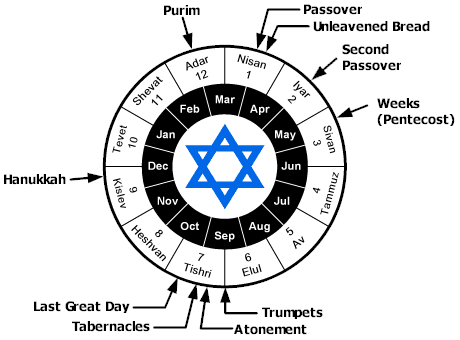
To further understand Jesus, the modern Christian necessarily must know how the Mosaic Law governed his life as a Jewish man. On the sermon on the mount, Jesus said: ‘Do not think that I have come to abolish the Law or the Prophets; I have not come to abolish them but to fulfil them’ (Matthew 5:17). Among the many requirements to be observed were the three annual pilgrimages. In this post, I will outline the Seven Feasts that punctuate the Jewish year, then and now. In a subsequent post I will examine how Jesus fulfilled them.
After this Jesus went about in Galilee. He would not go about in Judea, because the Jews were seeking to kill him. Now the Jews’ Feast of Booths was at hand. So his brothers said to him, “Leave here and go to Judea…(John 7:1-3 ESV)
Greek word translated: ἑορτῇ – heorte
The English word ‘feast’ has become associated with the act of eating, of feasting, but the original meaning was closer to the Old French word feste from which it was derived, a time of celebration. In the above passage the NIV uses festival for feast, which shares a similar root in the Latin, festivalis, a festal day or holy day, halig–dæg. We have lost the sense of the word in the modern English derivation ‘holiday’ now meaning a break from something, usually work.
In fact, feast, festival and holiday together cover the elements that went of a Jewish ‘sacred assemblies’: there was ritual sacrifice and eating that included elaborate food preparation and presentation, normal activities were forbidden and God was celebrated.
‘Feast’ can cause confusion, especially if we take a literal meaning from feasting, eating a resplendent meal. The Greek word ‘heorte’ itself stands for the Hebrew מועד – moed, which means festive season, and is particularly used in relation to the three pilgrimage festivals (plural: מועדים – moedim) of Passover, Weeks and Booths. While Passover celebrated was in one day, ‘the fourteenth day of the first month’ during which the paschal lamb was eaten, the Feast of Unleavened Bread, that directly followed it, lasted seven days, from Sabbath to Sabbath like the Feast of Booths*.
For the Jews, as for Jesus strict observance of these Feasts was paramount as it was decreed in Moses’ first declaration of God’s will (Exodus 23:14), then restated as law in the first reading in Leviticus and then in the second reading:
Three times a year all your men must appear before the Lord your God at the place he will choose: at the Festival of Unleavened Bread, the Festival of Weeks and the Festival of Tabernacles. (Deuteronomy 16:16)
Therefore, all Jewish men were required to be in Jerusalem for Passover, Weeks and Booths, the so-called pilgrimage festivals. For Jesus to refuse to go up to Judea, ie Jerusalem, was unthinkable and indeed he did go, only in secret – not as his unbelieving brothers wanted to him to, openly. Clearly, at this point of their eldest brother’s ministry James, Joseph, Simon and Judas (Jude) were impressed by his miracle working but not by his claims to his Messiahship.
Jesus went, as the gospel tells us, and continued to testify to his divinity. Although he based his ministry if Galilee, his pilgrimages to Jerusalem would have galvinised opinion and challenged the authorities as took the opportunity to teach in the Temple. But primarily he observed the law, his Father’s will – but he did more than observe, for he also fulfilled the law (Matthew 5:17).
Leviticus 23 records where God, through Moses, institutes the holy celebrations.
The Lord said to Moses, ‘Speak to the Israelites and say to them: “These are my appointed festivals, the appointed festivals of the Lord, which you are to proclaim as sacred assemblies. (Leviticus 23:1-2)
The festivals were these:
VERNAL FEASTS
Passover (pesach) – the Lord’s Passover begins at twilight on the fourteenth day (Nisan 14) of the first month. (23:5)
This is the spring feast of salvation, when the Jews remembered their deliverance from Egypt.
Unleavened Bread (chag hamotzi)
On the fifteenth day of that month the Lord’s Festival of Unleavened Bread begins; for seven days (Nisan 15-22) you must eat bread made without yeast. (23:6)
The seven days following Passover no leavened bread was eaten, as leaven was often associated with sin; this was period of shriving and as such Passover and Unleavened Bread are conjoined they were often referred to interchangeably. (* see note)
First fruits (yom habbikkurim)
…bring to the priest a sheaf of the first grain you harvest. He is to wave the sheaf before the Lord so it will be accepted on your behalf; the priest is to wave it on the day after the Sabbath. (23:10-11)
The date of this festival would therefore vary depending on where the Sabbath fell during the Feast of Unleavened Bread. It was dedicated to thanksgiving to God for the fertility of the land in which the early crop was presented.
Pentecost (Shavu’ot) – also called ‘The Feast of Weeks’
From the day after the Sabbath, the day you brought the sheaf of the wave offering, count seven full weeks. Count fifty days up to the day after the seventh Sabbath, and then present an offering of new grain to the Lord. From wherever you live, bring two loaves made of one fifth of an ephah of the finest flour, baked with yeast, as a wave offering of firstfruits to the Lord (23:15-17)
Again, the date was not fixed because it was calculated by counting seven weeks plus one day (hence the Greek pentekoste, fiftieth day) after the Sabbath of Unleavened Bread. It was a summer festival requiring the presentation of two loaves of bread baked with leaven.
[It should be noted that Jesus died on the day of Passover (the day of Salvation) buried on the inaugural day of Unleavened Bread (shriving of Sin) which coincided with the Sabbath, therefore, First Fruits (celebrating God’s the gift of life or grace) fell on Nisan 17, the date of Jesus resurrection; furthermore, it was at Pentecost that the Holy Spirit came to the disciples (the gift of God’s bounty or fullness) the two loaves now symbolising both Gentile and Jew.]
AUTUMNAL FEASTS
Trumpets (Yom Teru’ah)
On the first day of the seventh month (Tishri 1), you are to have a day of sabbath rest, a sacred assembly commemorated with trumpet blasts. (23:24)
This day, like Passover in spring marks the beginning of the autumnal festivals. It is also the first day of the Jewish New Year Rosh HaShanah (which means ‘the head of the year’)
Atonement (Yom Kippur)
The tenth day of this seventh month (Tishri 10) is the Day of Atonement. (23:27)
This a day of confession and most holy day of the Jewish calendar.
Tabernacles (Sukkot)
On the fifteenth day of the seventh month (Tishri 15-22) the Lord’s Festival of Tabernacles begins, and it lasts for seven days.
During this period, Jews would dwell under temporary shelters or ‘booths’.
[Messianic Jews maintain the autumnal feast will be fulfilled at Jesus’ second coming that will be announced with celestial trumpets; the day of confession will be judgment day before the White Throne of Christ after which the redeemed will dwell in God’s tabernacle, the New Kingdom.]
Jesus in his resurrection form explains first to Cleopas and his companion on the road to Emmaus ‘beginning with Moses and all the Prophets, he explained to them what was said in all the Scriptures concerning himself’ (Luke 24:27). And then to the ‘Eleven’ (disciples) ‘, ‘This is what I told you while I was still with you: everything must be fulfilled that is written about me in the Law of Moses, the Prophets and the Psalms’ (Luke 24:44). In part, this would have involved the ‘mystery’ of the festivals. The true purpose and meaning of festivals are revealed in Christ, who has fulfilled all seven, having enacted the first four.
As with every God-given rite decreed under the Law, these festivals were given to the Jews to make clear the Father’s sovereign redemptive purpose through his Son. While Gentiles are not called to observe the Feasts, all benefit by understanding better the purpose for each God intended.
[There are two other festivals that would have been known to Jesus but not given to the Hebrews on Mount Sinai; Chanukah marks the re-dedication of the Temple after it was desecrated in 165BC as prophesied by Daniel (8:9-14). It was during the ritual cleansing of the altar that Jesus declared himself as the Living Water (John 4:14). The other was Purim celebrated on Adar 14 was as now an outpouring of thanksgiving after Esther’s intervention overturned the King Xerses of Persia’s decree to kill all the Israelites then exiled in his kingdom. But as the festivals of Chanukah and Purim were instituted by men – Judas Maccabeus and Mordecai respectively – it is not likely they were part of fulfillment of the Law.]
* Understanding this will help to clarify the apparent discrepancy between the synoptic and John’s gospels, both state that Jesus died on the ‘Day of Preparation’, but that phrase could apply to the day on which the Passover Lamb was slaughtered, or the day before the Sabbath, in this case a Holy Sabbath because it coincided with the start of the Feast of the Unleavened Bread. For accuracy, there is no such discrepancy, Jesus died on the Passover, Nisan 15, not the Day of Preparation for the Passover, which would be Nisan 14.
 God Breathed Words