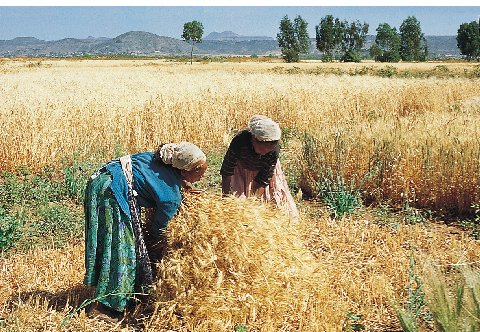
For those of you following my blog, I began with a look at the Jewish Feasts (Leviticus 23). You many have noted that the seven feasts are set in a pattern, three together (Passover, Leavened Bread and Firstfruits), one by itself (Pentecost) and, again, a cluster of three (Trumpets, Day of Atonement and Booths); this timing aligns with the three periods of harvest in Israel. (With God, there are no coincidences!) So, in this post we consider the word ‘harvest’ in a Biblical context.
Then his disciples said to each other, ‘Could someone have brought him food?’
‘My food,’ said Jesus, ‘is to do the will of him who sent me and to finish his work. Don’t you have a saying, “It’s still four months until harvest”? I tell you, open your eyes and look at the fields! They are ripe for harvest. Even now the one who reaps draws a wage and harvests a crop for eternal life, so that the sower and the reaper may be glad together. Thus, the saying “One sows and another reaps” is true. I sent you to reap what you have not worked for. Others have done the hard work, and you have reaped the benefits of their labour.’ (John 4:33-38)
Greek word translated: θερισμός; therismos (2326)
The Greek word therismos means the act of reaping, hence ‘reaper’ ‘reap’ and reaping derive from the same root: therizo, to reap (2325).
The English word harvest comes from the Anglo Saxon: hærfest, autumn (just as ‘lent’ comes from the word for spring, lencten). The root of the word harvest is likely to derive from the Indo-European root ‘kerp-’, for ‘to cut’ or ‘pluck’, in common with a Greek ‘karpos’ for fruit.
The Old English word for a harvest was onríptíd, meaning ‘the tide (time) to reap’. In a temperate climate such as northern Europe harvesting happens in autumn, hence the conflation of the name of the season with the activity.
The harvest referred to in the above passage from John are that of souls to be redeemed through Jesus’ saving work. Jesus draws the analogy by quoting a saying ‘It’s still four months until harvest.’
While people streamed out from the town of Sychar to greet him, the Messiah, Jesus is draws attention to what a testimony, in this case of one despised woman, can achieve. In so doing, he uses an adage based on common (local) knowledge that between period between harvests was just four months. To understand this adage, we have to know something of the unique climate of the Holy Land.
The climate of Israel has a modified Mediterranean climate, with short, hot dry summers (sub-tropical) and long, cool (but not cold) wet winters* which gives rise to a unique pattern of harvesting. In temperate climates, there is one period of harvest, autumn; but Israel there are three.
In the Judea of Jesus, the harvest calendar would be as follows:
- April – the barley harvest (Passover, Pesach and Unleavened Bread, Mazzot – the Firstfruit offering would be barley loaves)
- May – the wheat harvest – (Weeks/Pentecost, Shavuot)
- September/October/November – ‘In-gathering’ or the fruit harvest, beginning with grapes, figs and pomegranates, ending with olives (Tabernacles, Sukkoth).
Given there were three periods of harvest in Judea, each was celebrated with a pilgrimage festival to Jerusalem and the Temple.
Of course, it is not the reaping of grain stalks that Jesus is referring to in this passage. The use of such ordinary and everyday analogies did not disguise the spiritual metaphor at work. Jesus speaks with urgency: the harvest is always now.
We sit in the last days, a period of grace – but when Jesus returns then the final harvest of souls is in-gathered. None know when he will return, as Peter answered to those that scoffed ‘where is this “coming” he (Jesus) promised’:
…with the Lord a day is like a thousand years, and a thousand years are like a day. The Lord is not slow in keeping his promise, as some understand slowness. Instead he is patient with you, not wanting anyone to perish, but everyone to come to repentance. (2 Peter 3:8-9)
The harvest will come and it needs labourers, but Jesus advises us that those that labour may not see the bounty of the harvest – but to labour all the same, for there is not one but many harvests.
When he saw the crowds, he had compassion on them, because they were harassed and helpless, like sheep without a shepherd. Then he said to his disciples, ‘The harvest is plentiful but the workers are few. Ask the Lord of the harvest, therefore, to send out workers into his harvest field.’ (Matthew 9-36-38)
Jesus is warning his followers to labour through many harvests and to not rest until all is garnered.
Whoever sows to please their flesh, from the flesh will reap destruction; whoever sows to please the Spirit, from the Spirit will reap eternal life. Let us not become weary in doing good, for at the proper time we will reap a harvest if we do not give up. (Galatian 6:8-9)
In Sychar, the onlooking and amazed disciples had not done any sowing, that work had been done by many prophets before them – for the Samaritans revered the Pentateuch, the books of Moses – and Jesus, himself. But Jesus was encouraging them to reap and gather the harvest.
By God’s grace, the cultivation of souls is extended because his desire that none should perish, the four months is now 2000 years and, like the early disciples, all Christians should be expecting God to call time on his earthly creation. It is then the final winnowing will begin, the separation of the wheat from the chaff.
Jesus is thus announced by John the Baptist:
He will baptise you with the Holy Spirit and fire. His winnowing fork is in his hand, and he will clear his threshing-floor, gathering his wheat into the barn and burning up the chaff with unquenchable fire. (Matthew 3:11-12)
But until then mankind has the covenant of the rainbow:
‘As long as the earth endures, seedtime and harvest, cold and heat, summer and winter, day and night will never cease.’ (Genesis 8:22)
Jesus commands that all that follow him labour ceaselessly at both sowing and reaping because the harvest is at hand.
* In fact, Israel falls between three different climate zones.
 God Breathed Words