
I have been considering the Jewish Feasts. In this post, I will look in brief how they have been fulfilled in Christ. Of course, this is only one element of the fulfilment of the Law, but the festivals were given both for observance and for revelation:
‘Do not think that I have come to abolish the Law or the Prophets; I have not come to abolish them but to fulfil them…’ Matthew 5:17
First, a brief look at the word ‘fulfil’.
The Greek word translated ‘fulfilled’ is πληρόω, pléroó (G4137) “to make full”, “to complete”. This meaning aligns well, that is has etymological commonality with the Anglo Saxon fullfyllan that also means “to make full”. But of course, its contemporary meaning is “to complete”.
With his sixth word on the cross, Jesus says, ‘it is finished’ (John 19:30); the Greek here is τετέλεσται the perfect indicative tense of the verb τελέω, teleó (G5055) “to bring to an end”, “complete” or “fulfil”. Here Jesus is saying much more than “all is done” – the tense conveys a richer meaning. The complete rendering in English would say something like this: the task is undertaken but the benefits will unfold. In other words, the outworking of his sacrifice on the cross rolls forward. Jesus’ accomplishment is not just for that moment, but for all time.
And now for the example of fulfillment, the Jewish Feasts as given through the Law of Moses to the Israelites. While the Law and prophecies of the Old Testament point to Jesus and are all fulfilled in the him, the Feasts, some have already been enacted: Passover, Unleavened Bread, First Fruits and Weeks. Yet to be enacted are: Trumpets, Day of Atonement and Booths.
Therefore, to consider each in turn:
Passover: Jesus died on the Feast of Passover (keep in mind that the Jewish day, in this case Nisan 15, begins at sunset and ends at sunset the next day). Jesus inaugurates the new Passover feast that we call variously ‘the Lord’s Supper’ or ‘Eucharist’ and then, as the perfect lamb, is himself consumed on the cross later that same day.
[This is why, that evening, he points forward by speaking of his blood poured out and his body broken like unleavened bread of the Passover meal. It is important to note that he is not simply his death that he draws attention to by this, for that he might have been sacrificed on Nisan 14, that afternoon along with the thousands of lambs. He dies on the feast not on the day of preparation for the feast. As noted, when John speaks of the Day of Preparation (19:31) he is referring to the Sabbath and the beginning of the Feast of Unleavened Bread, but he makes it clear that before the meal held after sunset ‘it was just before the Passover Festival; John 13:1.]
John saw Jesus coming towards him and said, ‘Look, the Lamb of God, who takes away the sin of the world!’ (John 1:29)
Unleavened Bread: John refers to the Sabbath as special and this is because of the conjunction of the first day of the Feast of Unleavened Bread with the Sabbath. This feast where for seven days the Jewish household does without leaven, which is cleansed from the house before Passover. Leaven is associated with sin. The fulfillment then is with Jesus taking all the sins of the world on him and away from mankind, just as the leaven is removed from every household.
Get rid of the old yeast, so that you may be a new unleavened batch – as you really are. For Christ, our Passover lamb, has been sacrificed. Therefore let us keep the Festival, not with the old bread leavened with malice and wickedness, but with the unleavened bread of sincerity and truth. (1 Corinthians 5:7-8)
Firstfruits: Again, because of the unusual conjunction of days of the week with dates on the calendar, Firstfruits is the next day. This is the first harvest festival (see earlier blog post on the three harvest-tides of Israel). Jesus fulfils this festival through the resurrection, the first fruit of the new creation.
But Christ has indeed been raised from the dead, the firstfruits of those who have fallen asleep. (1 Corinthians 15:20)
So, to summarise: Jesus dies and rises on third day (note: his time in the tomb is not 72 hours or three full days – this is not at odds with Matthew 12:40 because a part of a day represents a full day.)
- End of Day One – Passover, death and consumption of perfect sacrifice.
- Day Two – Unleavened Bread, Jesus takes upon himself the sins of the world.
- Beginning of Day Three – Firstfruits, the first born of the new creation.
Pentecost: This is second harvest festival. Jesus is seen in resurrected body for forty days then ascends. Ten days later, The Holy Spirit comes upon the disciples and Peter harvests three thousand souls that day. This is then new creation that is now available to all who would be reborn in the spirit.
When the day of Pentecost came…suddenly a sound like the blowing of a violent wind came from heaven…they saw what seemed to be tongues of fire that separated and came to rest on each of them. All of them were filled with the Holy Spirit and began to speak in other tongues as the Spirit enabled them. (Acts 2:1-4)
These then are the festivals that have been fulfilled and enacted. The three remaining are fulfilled and yet to be enacted:
Trumpets: Over the last day, a period of grace, many more will come to faith in Jesus as the Christ and will be reborn through fire and water. But there will come a day (Jesus says that none can predict, not even himself Matthew 24:36) that God the Father will foreclose on the fallen world. Jesus predicts:
…all the peoples of the earth will mourn when they see the Son of Man coming on the clouds of heaven, with power and great glory. And he will send his angels with a loud trumpet call, and they will gather his elect from the four winds, from one end of the heavens to the other.’ (Matthew 24:30-31)
Paul elaborates thus:
Listen, I tell you a mystery: we will not all sleep, but we will all be changed – in a flash, in the twinkling of an eye, at the last trumpet. For the trumpet will sound, the dead will be raised imperishable, and we will be changed. (1 Corinthians 15:51-52)
For the Lord, himself will come down from heaven, with a loud command, with the voice of the archangel and with the trumpet call of God, and the dead in Christ will rise first. (1 Thessalonians 4:16)
Trumpets will sound to mark the end of days; some will not die as Jesus predicted, but will be changed into their resurrection bodies. Others, of course, will not.
Day of Atonement: In the tabernacles, blood was spilt on the mercy seat of the arc of the covenant. This prefigures Jesus substitutionary sacrifice and his intercession in the heavenly throne room. This is then the Day of Judgement, when all shall give an account of themselves.
Then I saw a great white throne and him who was seated on it…and I saw the dead, great and small, standing before the throne, and books were opened. Another book was opened, which is the book of life. The dead were judged according to what they had done as recorded in the books. The sea gave up the dead that were in it, and death and Hades gave up the dead that were in them, and each person was judged according to what they had done. Then death and Hades were thrown into the lake of fire. The lake of fire is the second death. Anyone whose name was not found written in the book of life was thrown into the lake of fire. (Revelation 20:11-15)
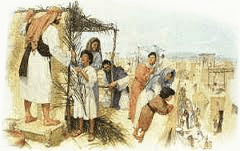
Booths or Tabernacles: Having been separated as goats and sheep, those that have benefited from the double imputation of Jesus sacrifice, our sin for his righteousness, now reside in the new earth as described in many places in the Bible. The righteous are now ‘tabernacled’ with God, who abides with his people, as once He did with Adam:
Then I saw ‘a new heaven and a new earth,’ for the first heaven and the first earth had passed away…And I heard a loud voice from the throne saying, ‘Look! God’s dwelling-place is now among the people, and he will dwell with them. They will be his people, and God himself will be with them and be their God. (Revelation 21:1-3)
God who was once only seen in fire or cloud, or present in the Holy of Holies, or seen in Jesus, or even indwelling through the Holy Spirit, is now revealed in all his Glory, while his Son is King ruling from his throne.
Thus, the final act of God’s great plan is to restore us to his presence.
 God Breathed Words