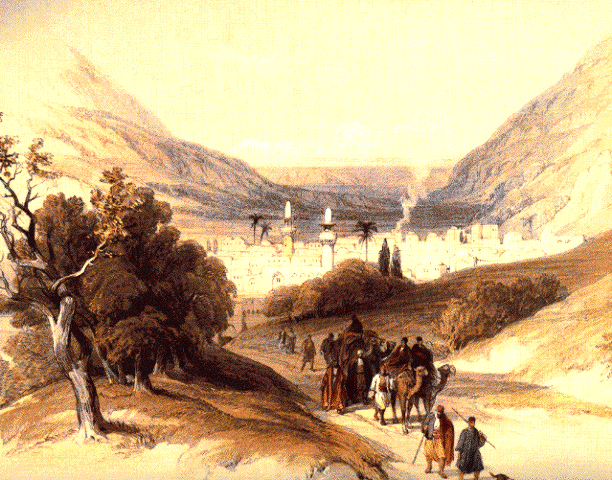
Abram travelled through the land as far as the site of the great tree of Moreh at Shechem. At that time, the Canaanites were in the land. The Lord appeared to Abram and said, ‘To your offspring, I will give this land.’ So, he built an altar there to the Lord, who had appeared to him. (Genesis 12:6-7)
This is the first mention of Shechem. שְׁכָם Shekem (Strong’s Hebrew 7927) means ‘ridge’ or ‘shoulder’ and refers to the city’s site on a saddle between Mounts Ebal and Gerizem, high it the Samarian Hills to the north of Jerusalem. Today it is known as Nablus.

Shechem was a hugely significant and pivotal place in God’s overall plan to restore his wayward creatures, mankind. It is mentioned 54 times in nine different books of the Bible. Here are some examples.
Abraham’s grandson, Jacob purchased land there:
After Jacob came from Paddan Aram, he arrived safely at the city of Shechem in Canaan and camped within sight of the city. For a hundred pieces of silver, he bought from the sons of Hamor, the father of Shechem, the plot of ground where he pitched his tent. There he set up an altar and called it El Elohe Israel. (Genesis 33:18-20)
While the Israelites were developing into a nation in Egypt, Shechem became a major Canaanite city. When the Israelites entered the promised land under Joshua, the region around Shechem was given to the half-tribe of Manasseh. Shechem became the chief city of Israel to which Joshua ‘gathered all the tribes of Israel’. (Joshua 24:1)
It was in Shechem that Joshua declared a new covenant between God and his chosen people (Joshua 24:2-28) and where Joseph’s bones were buried on the land his father had purchased (Joshua 24:32).
After the death of Gideon, (also known as Jerub-Baal – ‘let Baal contend’), Shechem was the focus of the battle for his succession. This featured his son, Abimelek, born to a concubine from Shechem, who slew his 70 half-brothers. Jotham was the only brother to escape, by going into hiding, but not before declaring a prophesy over the land. God used the Canaanites of Shechem to punish Abimelek and the errant Israelites, but he cursed them in turn:
God also made the people of Shechem pay for all their wickedness. The curse of Jotham, son of Jerub-Baal, came on them. (Judges 9:57)
Following the division of David and Solomon’s kingdom, Jeroboam chose Shechem to be the capital of the northern state, Israel.
By the time of Jesus, the city was known as Sychem; Συχέμ (Strong’s Greek 4966) or Sychar.
In the New Testament, there are two distinct and exclusive occurrences, the first peculiar to Sychem/Sychar, the other to the whole of Samaria.
The first involved Jesus, himself:
(Jesus) left Judea and went back once more to Galilee. Now he had to go through Samaria. So, he came to a town in Samaria called Sychar, near the plot of ground Jacob had given to his son Joseph. Jacob’s well was there, and Jesus, tired as he was from the journey, sat down by the well. (John 4:3-6)
What follows is both wholly remarkable. Having born witness of himself as the Messiah to the Samaritan woman (before the disciples or indeed any Jews), the whole town is drawn to him and believe Jesus is the anointed one of the Scriptures. This, despite the fact that the Samaritans revered only Moses as their prophet, solely basing their religion on the Pentateuch.
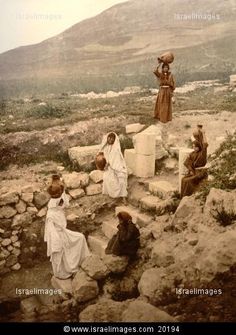
Could it be that this, added to Jesus’ mission to Sychar, lifts Jotham’s curse, thereby redeeming those left under it?
The second occurence is in ‘Acts’. Luke records Philip’s ground-breaking mission to ‘a city in Samaria’ (Acts 8:5). This is assumed to refer to Sebaste, Herod the Great’s name for the city of Samaria; however, there can be little doubt that in travelling north the apostle would have passed through Sychar, just as Jesus had done. But there was more:
When the apostles in Jerusalem heard that Samaria had accepted the word of God, they sent Peter and John to Samaria. When they arrived, they prayed for the new believers there that they might receive the Holy Spirit, because the Holy Spirit had not yet come on any of them; they had simply been baptised in the name of the Lord Jesus. Then Peter and John placed their hands on them, and they received the Holy Spirit. (Acts 8:14-17)
This double act seems unique, because the usual experience of the convert, acceptance of the word and indwelling of the Holy Spirit, is unified and interdependent.
The first witnesses of Christ were the Jews, the survivors of the southern kingdom, Judah (Judea); however, the second nation on God’s list were the Samaritans, who were remnants of the tribes of the northern kingdom that were dispersed by and lost to Assyria. Before his Ascension, Jesus commissioned his disciples to be apostles commanding them:
…you will be my witnesses in Jerusalem, and in all Judea and Samaria, and to the ends of the earth… (Acts 1:8)
The Jews of Jerusalem bore a double revelation of Christ, first by the death and resurrection at Passover, the second at Pentecost by the coming of the Holy Spirit. The Samaritans are the subjects of the next apostolic mission, but they also receive the fulfillment of the Word and infilling of the Spirit separately.
There can be no doubting the importance to God of the town of Shechem and its people, Samaritans.
 God Breathed Words