…the Son of Man is Lord even of the Sabbath.’ (Mark 2:28)
The Greek word κύριος kyrios (Strongs 2962) -and its various declensions -appears 722 times in the New Testament, most often in reference to Jesus; it means lord or master, or properly ‘a person possessing absolute rights of ownership’.
In the early Anglo Saxon kyrios was translated as drihten. For example, in the Wessex Gospels, the passage Mark 2:28 NIV:
So the Son of Man is Lord even of the Sabbath…
is written:
gitodlice drihten is mannes sunu eac sþylce restedæges.
In Anglo Saxon, drihten was used to translated kyrios and is completely synonymous with ‘absolute ruler’, yet by the time of Tyndale the verse was written:
‘wherefore is the sone of man lorde even of the saboth daye’
Therefore, drihten had fallen from usage in Middle English; ‘lord’ had became the standard English translation of kyrios. This gives the English speaker a whole new range of meaning once we realise the derivation of ‘lorde’.
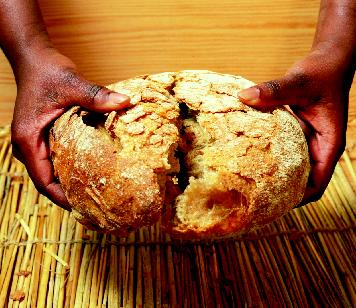
We obtain the modern word ‘lord’ from hláford which is a contraction of hláfwearde, or loaf-ward (loaf keeper or loaf-provider) or in the colloquial, bread-giver. We gain the modern word loaf from hláf but in fact, it meant bread.
[The word bread is later in origin and came to us via the Norse word brauð – therefore, a ‘loaf of bread’ is actually tautology.]
Now given Anglo Saxon societal structure was intensely hierarchical, they used a plethora of nouns for headship. Here follows but a few, all broadly synonymous with hláford: ágend, béaggiefa, bealdor, bregu, brytta, fréa, goldwine, guma, hæsere, hearra, léodgebyrga, onwealda, þengel.
This list is extended through combination of words for ‘lord’ with each other, such as ágendfréa, or by adding adjectives like eald ‘old or wise’, sige ‘victorious’, héah ‘high’ or riht ‘rightful’ or with other nouns like wine ‘friend’, giving ealdhláford, sigedryhten, héahfrea, rihthláford or winedryhten. In all there are well over a hundred variations from which to choose.
And yet, The Holy Spirit led the English to select the one word that has as its root ‘bread’. It is of course, full of association with Jesus.
Then Jesus declared, ‘I am the bread of life. Whoever comes to me will never go hungry… (John 6:35)
Also:
I am the living bread that came down from heaven. Whoever eats this bread will live forever. This bread is my flesh, which I will give for the life of the world. (ibid 6:51)
Christians break bread in remembrance of Jesus, just as Jesus broke bread and gave it to his disciples. He is indeed our Lord, our loaf-ward and bread-giver.
But least the divine symmetry should escape notice, it is with disobedience that Adam and Eve eat of the forbidden fruit, and it is through obedience to the ordnance of Eucharist that all can be redeemed through eating the body of Christ. And Jesus makes salvation conditional on this.
Jesus said to them, ‘Very truly I tell you, unless you eat the flesh of the Son of Man and drink his blood, you have no life in you. Whoever eats my flesh and drinks my blood has eternal life, and I will raise them up at the last day. For my flesh is real food and my blood is real drink. (John 6:53-55)
And Jesus gave the model prayer in which all should ask ‘give us today our daily bread’ (Matthew 6:11).
How appropriate we use ‘lord’ over any other Anglo-Saxon derived word among the multiplicity of alternatives that were once available in Early English.
 God Breathed Words