Who, or what, is a Gentile and, Biblically, what is the significance of this status after Christ? In this examination, I look at the word which was used to represent all those who were ‘not of Israel’.
Inasmuch as I am the apostle to the Gentiles, I take pride in my ministry in the hope that I may somehow arouse my own people to envy and save some of them. (Romans 11:13)
Greek word translated: ἔθνος; ethnos (1484)
The literal meaning of ethnos is (a) race or people, but it used here specifically to distinguish anyone who is not of Paul’s people, the Hebrews or Jews, for whom he grieved over their rejection of Jesus as Messiah.
The word we use in English derives from the Latin plural noun, gentilis, which means ‘men of family’, ‘tribe’ or ‘race’ but also had the meaning ‘foreigners’ or ‘barbarians’. For the Jew of Jesus’ time, a Gentile was a ‘Greek’.
There is neither Jew nor Gentile, neither slave nor free, nor is there male and female, for you are all one in Christ Jesus. If you belong to Christ, then you are Abraham’s seed, and heirs according to the promise. (Galatians 3:28-29 NIV)
The word translated as Gentile is Ἕλλην; Hellén (Strong’s 1672) meaning ‘Greek’ and other more literal versions, e.g. ESV, NKJV, say: ‘neither Jew nor Greek’.
In 332BC, Alexander the Great conquered the people and land of Israel. Following his death, his successors (Diadochi) divided his empire to rule over it, adopting the Persian model as ‘satraps’. Therefore, prior to the Roman conquest (63BC) the Jews had been ruled by Greeks, first by the Ptolemies then the Seleucids. This is referred to as ‘The Hellenistic Age’, and is the reason, of course, that the New Testament was written in Alexandrian Greek, also call Koine or ‘common Greek – the ‘shared’ tongue of the Middle East at that time.
The ‘Greeks’, then, had been the oppressors long before the Romans and by the time of the Maccabean rebellion (168-164BC) their influence had sunk deep roots into Judea, its culture and society. ‘Hellenism’, with its paganism, ran counter to God’s Law. For the Jews, jealous of their privileged status as God’s people, this was a grave state of affairs.
While there was idolatry, with temples adorned with statues to the Greek gods, with Antiochus IV taking to himself the title ‘Theos Epiphanes’, which means ‘the manifest god’, or with the desecration of the Temple by sacrificing swine on a pagan altar to Zeus, perhaps the greatest threat came from the seduction of Jews, craving sophistication perhaps, to the Greek culture. This wish to assimilate and deny their Jewishness drove many to take extreme measures.
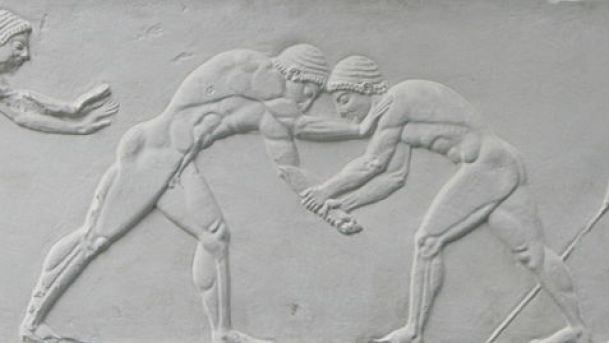
Young Jewish men joined in the Greek games and received training at the Gymnasia in Jerusalem and because such events were undertaken naked, they found ways to undo their circumcision, a practice known as epispasm (επισπασμοσ epispasmos). This was the apostate context into which the early church was placed. As Peter writes, not only addressing the Gentiles among the church:
For you have spent enough time in the past doing what pagans (ethnos) choose to do – living in debauchery, lust, drunkenness, orgies, carousing and detestable idolatry. (1 Peter 4:3)
And this societal and religious context replicated at least some of the conditions that the tribes of Israel had encountered on reaching the promised land (with notable exception of human sacrifice).
In the Old Testament, the behaviour Peter describes is also intrinsically bound the worship of idols. When the Israelites finally entered Canaan, they were under specific instruction to eradicate the other tribes, such was their offence to God.
…in the cities of the nations the Lord your God is giving you as an inheritance, do not leave alive anything that breathes. Completely destroy them – the Hittites, Amorites, Canaanites, Perizzites, Hivites and Jebusites – as the Lord your God has commanded you. Otherwise, they will teach you to follow all the detestable things they do in worshipping their gods, and you will sin against the Lord your God. (Deuteronomy 20:16-18)
Genesis 10 gives lists of these nations, as everyone man and woman would by necessity come from Noah’s bloodline.
From these the coastland peoples of the Gentiles were separated into their lands, everyone according to his language, according to their families, into their nations. (Genesis 10:5)
In Hebrew, the word rendered ‘Gentiles’ is גּוֹי goy (Strong’s 1471 plural goyim) which although means ‘people’ and specifically came to mean those ‘not of Israel’.
In this context, both from Scripture, heritage and the living memory of conditions under the Seleucids, it is hard to overestimate the sense of otherness Jews felt toward all other nations. But most of all, the Jews were acutely proud of their favoured status among all the nations.
Paul lists the benefits of that divine favour shown to Israel and, as he does so, the list becomes doxology;
Theirs is the adoption to sonship; theirs the divine glory, the covenants, the receiving of the law, the temple worship and the promises. Theirs are the patriarchs, and from them is traced the human ancestry of the Messiah, who is God over all, forever praised! Amen. (Romans 9:4-5)
When Paul was appointed the apostle to the Gentiles and taught that it was be faith of Jesus Christ alone that God would be reconciled, it was truly shocking; however, it is also important not to see this a simple and unadulterated racism on the part of the Jews – ethnic oppression, the default setting for mankind, of which the Jews have suffered more than most. While it is the case that Jews did reserve a specific hatred for the Samaritans, whom they resented for claiming joint ancestry from Jacob, whether they indiscriminately classed anyone Greek, Pagan or Gentile, it signified nothing other than a statement of the fact that Jews were set apart by God and ipso facto everyone else was of no value to God – and therefore of little note. It was not a firm conviction of God’s choices, not a reflection of their own prejudice.
That said, racial pride had set in and was exposed by Jesus; not least, in his rejection as the Christ. ‘Can any good come out of Nazareth’, remarks Nathanael (John 1:46) – Nazareth was an insignificant village in the region of Galilee, not Judea the homeland of the Jews. Paul, despairs over this rejection:
I speak the truth in Christ – I am not lying; my conscience confirms it through the Holy Spirit – I have great sorrow and unceasing anguish in my heart. For I could wish that I myself were cursed and cut off from Christ for the sake of my people, those of my own race, the people of Israel. (Romans 9:1-4)
His plea is personal and verses 3 into 4 translated literally reads: ‘for I was wishing, I myself, to be anathema from the Christ – for my brethren, my kindred, according to the flesh, who are Israelites’.
Yet, in the head quotation to this examination, Paul explains how the Gentiles benefit from this rejection, adding:
Israel has experienced a hardening in part until the full number of the Gentiles has come in, and in this way all Israel will be saved. (Romans 11:25-26).
Paul is magnanimous, echoing the magnanimity of God’s redemptive plane for all mankind.
But it can be seen that for the first Christians, almost exclusively Jews, accepting Greeks into their fellowship was a huge step and a test of their faith and understanding of the Gospel. Even the apostles got it wrong.
Paul rebuked Peter (also known by his Aramaic name given him by Jesus, Cephas) over this issue:
When I saw that they were not acting in line with the truth of the gospel, I said to Cephas in front of them all, ‘You are a Jew, yet you live like a Gentile and not like a Jew. How is it, then, that you force Gentiles to follow Jewish customs?
‘We who are Jews by birth and not sinful Gentiles know that a person is not justified by the works of the law, but by faith in Jesus Christ. So we, too, have put our faith in Christ Jesus that we may be justified by faith in Christ and not by the works of the law, because by the works of the law no one will be justified. (Galatians 2:14-15)
The early church was riven by a dispute over whether Gentiles must first become Jews, by undergoing circumcision, before being accepted into the communion. ‘Judaizers’, as the proponents were called, were finally won over at the Council of Jerusalem (AD 50) which is described by Luke in Acts chapter 15.
The critical factor for Jews was in the outward sign (of circumcision) and of behaviour (cleanliness: ablution rituals, consuming ‘clean’ food) and how that demonstrated their Godliness through observance of the Law and the Mishnah (commentary on Scripture from which came extra-biblical rules). This was not the teaching of Jesus, who exposed the dark and sinful heart of each person and offered the true cleansing, purification by the taking upon himself sin and offering his righteousness in return, this by his death on the cross.
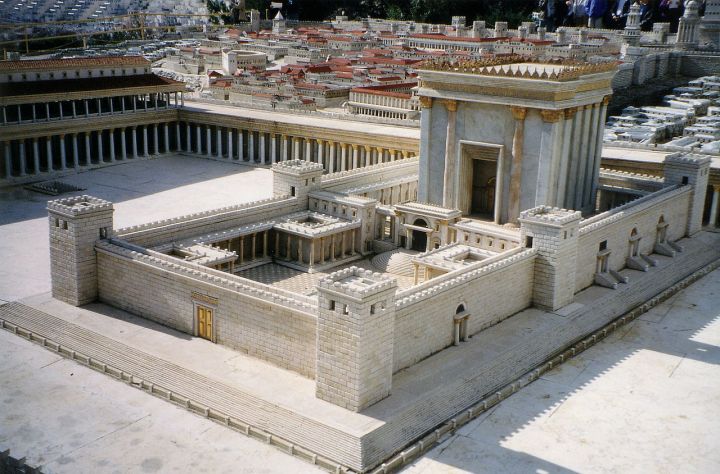
Jesus broke down the impediments between peoples to remove the outward differences of which there was a powerful example at the epicentre of the Jewish religion, the Temple. Upon the Temple Mount there was a Court of the Gentiles that was the only area non-Jews could enter. It was bounded by a barrier called the soreg that kept the non-Jew from the Temple itself.
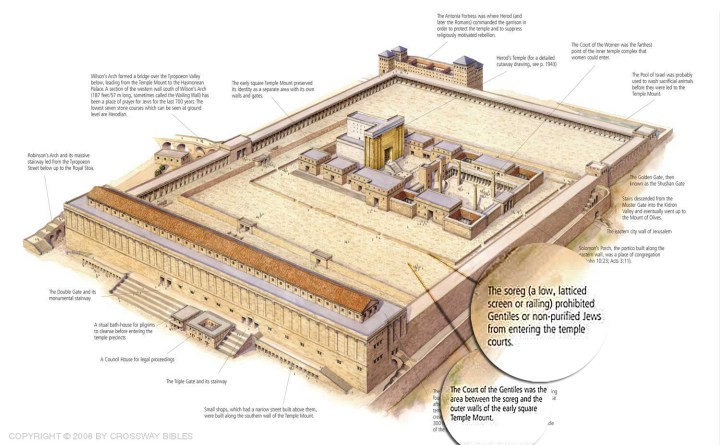
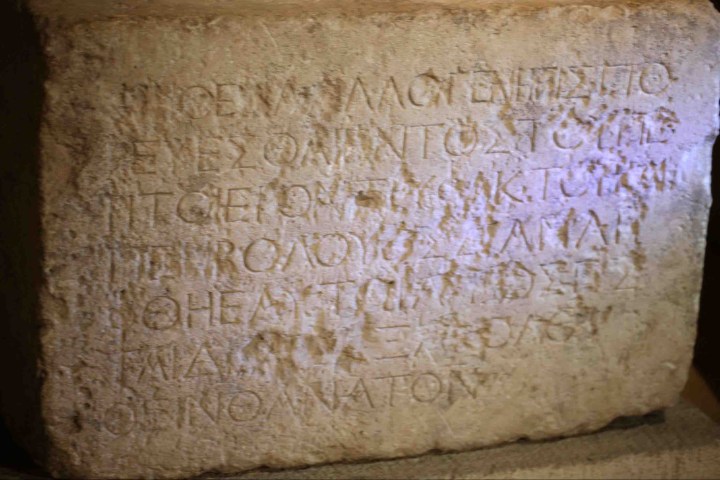
The soreg bore numerous stones bearing the following legend in Greek:
No intruder is allowed in the courtyard and within the wall surrounding the temple. Whoever enters will invite death for himself.
This was taken from Numbers 1:51:
Whenever the tabernacle is to move, the Levites are to take it down, and whenever the tabernacle is to be set up, the Levites shall do it. Anyone else who approaches it is to be put to death.
It is most likely that Paul had the soreg, the wall of demarcation, in mind when he wrote:
Therefore, remember that formerly you who are Gentiles by birth and called ‘uncircumcised’ by those who call themselves ‘the circumcision’ (which is done in the body by human hands) – remember that at that time you were separate from Christ, excluded from citizenship in Israel and foreigners to the covenants of the promise, without hope and without God in the world. But now in Christ Jesus you who once were far away have been brought near by the blood of Christ.
For he himself is our peace, who has made the two groups one and has destroyed the barrier, the dividing wall of hostility, by setting aside in his flesh the law with its commands and regulations. His purpose was to create in himself one new humanity out of the two, thus making peace, and in one body to reconcile both of them to God through the cross, by which he put to death their hostility. He came and preached peace to you who were far away and peace to those who were near. For through him we both have access to the Father by one Spirit. (Ephesians 2:11-18)
Before Jesus, God had only revealed himself and was accessible to his chosen people, and Jesus himself came first to the Jews, telling a Canaanite woman who was begging him to cast demons out her daughter:
‘I was sent only to the lost sheep of Israel.’ (Matthew 15:24)
Even so, Jesus did as she asked, and Jesus also ministered to many other Gentiles. With his final words before his Ascension, Jesus made it very clear to those listening that the Gospel was to proclaimed to the all the nations, and ‘that you will be my witnesses in Jerusalem, and in all Judea and Samaria, and to the ends of the earth’ (Acts 1:8).
So, to repeat, now:
…there is neither Jew nor Gentile…for you are all one in Christ Jesus. (Galatians 3:28)
 God Breathed Words