There are two words that often used synonymously, jealousy and envy; but in actuality they have different meanings and applications. The simple difference between jealousy and envy: one is jealous of what you already possess but envious of others who have what you desire. By illustration, if a woman sees her husband flirting, she is jealous; but if she desires another woman’s husband, she is envious. While the first man is hers by right, the other is not; and to obtain the latter, she would have to take that man from his wife. Thus, envy is sin while jealousy is not. First, I look at Jealousy from a Biblical perspective.
I, the LORD thy God, am a jealous God. (Exodus 20:5)
Hebrew word translated: קַנָּ֔א – qanna
The Hebrew word, qanna, occurs just six times in the Old Testament (in Exodus, chapters 20 and 34, and Deuteronomy chapters 4,5 and 6). Each occurrence is related to God’s exclusive nature.
In common usage, envy and jealousy are loosely synonymous, but in Scripture, we see a stark divergence of meaning. God clearly cannot envy his creation and that makes no sense at all; he freely gave us our attributes, actually his attributes, as he ‘created mankind in his own image’ (Genesis 1:27). So, if it is not covetousness, then this leaves the feeling of hurt and rage we experience as the wounded party with betrayal or frustration. Are these ‘base’ feelings, really compatible with a loving God?
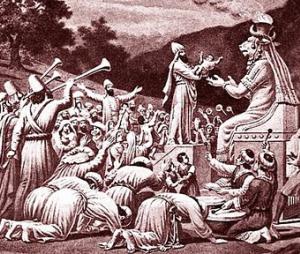
Hosea was God’s prophet who (almost certainly) lived in the northernmost of the divided kingdom of David, Israel. During Hosea’s lifetime, Israel was ruled by Jeroboam, the fourteenth king. Jeroboam reined for forty-one years and was a temporally successful and able ruler, but spiritually Israel was bankrupt. Idolatry flourished, altars to Baal and Astarte were built on mountains and there was even the abomination of child sacrificed undertaken by the cult following of Moloch. Under Jeroboam the commandments of God were not just disregarded but viewed with contempt.
Hosea was God’s chosen instrument through whom He condemned Israel for its idolatry – but in a unique fashion.
When the Lord began to speak through Hosea, the Lord said to him, ‘Go, marry a promiscuous woman and have children with her, for like an adulterous wife this land is guilty of unfaithfulness to the Lord.’ (Hosea 1:2)
God required that Hosea marry disastrously, and chose for him a bride, called Gomer, who was a prostitute. God wished to use this example to demonstrate the anger of one grievously wronged through the paradigm of marriage and infidelity. Although he did not want to punish Hosea, God did want to punish the King, Jehu’s great grandson.
Like Isaiah’s offspring, Hosea was to name his children as a living declaration of prophecy, starting with his son by Gomer:
Then the Lord said to Hosea, ‘Call him Jezreel, because I will soon punish the house of Jehu for the massacre at Jezreel, and I will put an end to the kingdom of Israel. In that day, I will break Israel’s bow in the Valley of Jezreel.’ (Hosea 1:4-5)
God also acknowledged and rewarded the faithfulness of the southern kingdom, Judah, in stark contrast to Israel.
Gomer conceived again and gave birth to a daughter. Then the Lord said to Hosea, ‘Call her Lo-Ruhamah (which means “not loved”), for I will no longer show love to Israel, that I should at all forgive them. Yet I will show love to Judah; and I will save them – not by bow, sword or battle, or by horses and horsemen, but I, the Lord their God, will save them.’
After she had weaned Lo-Ruhamah, Gomer had another son. Then the Lord said, ‘Call him Lo-Ammi (which means “not my people”), for you are not my people, and I am not your God. (Hosea 1:6-9)
The cause of God’s anger is the northern kingdoms flirtation with other (false) Gods. And they were warned centuries before. When stating in the second commandment that the Israelites were not to bow down before other Gods, he warns that he will:
punish(ing) the children for the sin of the parents to the third and fourth generation of those who hate me,… (Exodus 20:5)
It is important that we learn something of the nature of God from this passage, as God is never changing.
The exemplar of God loving Israel as a groom does his bride is often seen in parallel with Christ ‘marriage’ to his church and if we are unfaithful it angers God but wounds Jesus.
God is no less jealous of his chosen people, the elect, nor his punishment less. Under the old covenant, God took immediate steps so that we might learn of his mind and purpose, so that under the new covenant, we might not mistake deferred retribution for disinterest. God is as partial as before but we have an intercessor in his Son.
Jesus provides us a way back to his father and the reward is the loving relationship is restored. We see the alternative that was promised to the faithful:
…but showing love to a thousand generations of those who love me and keep my commandments. (Exodus 20:6)
God is love, yet it is the commandment to love God that is disregarded.
Love is not genuine if the lover is indifferent. Spurned, any lover is jealous. If we do not return the love shown us, but dally with other ideas, or spend time away from our relationship in earthly preoccupations, we are no different than the wanton, Gomer. Yet Hosea was reconciled with his wife as God is with us, through Christ Jesus. He bares the wounds of our licentiousness on his broken body so that we can be reconciled to God and he to us.
This is the covenant that is foretold to Hosea:
‘In that day,’ declares the Lord,
‘you will call me “my husband”;
you will no longer call me “my master”.
I will remove the names of the Baals from her lips;
no longer will their names be invoked.
In that day, I will make a covenant for them
with the beasts of the field, the birds in the sky
and the creatures that move along the ground.
Bow and sword and battle
I will abolish from the land,
so that all may lie down in safety.
I will betroth you to me for ever;
I will betroth you in righteousness and justice,
in love and compassion.
I will betroth you in faithfulness,
and you will acknowledge the Lord. (Hosea 2:16-20)
Our debauched nature that led us astray so that we fooled around with our ‘Baals’ is made righteous in Christ, thus our salvation is foreseen:
I will plant her for myself in the land;
I will show my love to the one I called “Not my loved one”.
I will say to those called “Not my people”, “You are my people”;
and they will say, “You are my God.”’ (Hosea 2:23)
 God Breathed Words