
In this post on my blog ‘God-breathed Words’, I take a look at temptation and find that both the original Greek and Hebrew words in the Bible have a range of meaning that includes ‘test’, ‘assay’, ‘prove’ and ‘trail’.
When tempted, no one should say, ‘God is tempting me.’ For God cannot be tempted by evil, nor does he tempt anyone; but each person is tempted when they are dragged away by their own evil desire and enticed. Then, after desire has conceived, it gives birth to sin; and sin, when it is full-grown, gives birth to death. (James 1:13-15)
Greek word translated: πειράζει peirazei (Strong’s 3987)
The verb to tempt, ‘to entice, lure to evil or sin’ comes from the Old French, tempter, deriving from the Latin temptare, ‘to feel, try out, prove, attempt to influence or test’ and it is the sense of ‘testing’ that Biblical temptation is best understood.
James reveals something that some liberal Christians now deny; the wish to do evil lies within and Satan’s role is, at worst, that of a deceiver. He has no power over anyone reborn of the Spirit.
The first temptation recorded is that of ‘the woman’ by the serpent. But Genesis records that though the serpent may have opened the door for her to ponder God’s word with a simple question, ‘Did God really say, “You must not eat from any tree in the garden”?’, it her own desire that lead her on.
When the woman saw that the fruit of the tree was good for food and pleasing to the eye, and also desirable for gaining wisdom, she took some and ate it. (Genesis 3:6)
Here then can be seen the process that James outlines; Satan insinuates a suggestion, but it is indwelling desire that is stirred; then relinquishing all self-control, the desire becomes sin with dire and far-reaching outcomes.
But two things should be noted: desire is God-given and in itself is not evil, rather it is the object of the desire that defines. Secondly, there is an opportunity to discern that the desire is misplaced, and like ‘the woman’, the door can be slammed shut. As with every human made in the image of God, ‘the woman’ had a conscience and knew right from wrong. But God is gracious and provides to not only discern right from wrong, but a way to resist, through his Spirit. This is how Paul can write:
I myself in my mind am a slave to God’s law, but in my sinful nature a slave to the law of sin. (Romans 7:25)
Consciences are weak and without the Holy Spirit, there is no awareness of sin, just the gratification of evil, that is our own desire. With the conviction He brings, sin is exposed along with the sinful nature. God’s law is keeping the commandments of Jesus and deciding to not sin; temptation, test or trail exposes the sinful nature.
Satan is a source of temptation, that is clear, but ‘the tempter’ operates within by God’s parameters, it is His sovereign desire is initiate perfection through the fallibility and stumbling of his earthly servants. As Jesus says to Paul, in regard of his weakness (which may have been an ailment, but equally could be a habitual sin: ‘a thorn in my flesh, a messenger from Satan’)
‘My grace is sufficient for you, for my power is made perfect in weakness.’ (2 Corinthians 12:7 and 9)
Satan is under the authority of God, if not we would have two powers and dualistic cosmos, not monotheistic. The agency of Satan is exposed in several passages in the Bible. First in the Book of Job. Job is tested at God’s suggestion:
…The Lord said to Satan, ‘Have you considered my servant Job? There is no one on earth like him; he is blameless and upright, a man who fears God and shuns evil.’ (Job 1:8)
And under limits strictly set by God:
The Lord said to Satan, ‘Very well, then, everything he has is in your power, but on the man himself do not lay a finger.’ (ibid 1:12)
Revised after further pleading from Satan:
The Lord said to Satan, ‘Very well, then, he is in your hands; but you must spare his life.’ (ibid 2:6)
As is seen, Satan is merely God’s agent in visiting upon Job affliction and calamity. Another example of Satan’s agency is provided in Luke’s Gospel. Jesus predicts Peter will undergo a test, he says this to him impetuous disciple:
‘Simon, Simon, Satan has asked to sift all of you as wheat. But I have prayed for you, Simon, that your faith may not fail. And when you have turned back, strengthen your brothers. (Luke 22:31-32)
And so Simon was tested, but though he thrice denied Jesus, his faith did not fail.
The Greek word peirasmos translates both tempt and test, for example:
Consider it pure joy, my brothers and sisters, whenever you face trials (peirasmos) of many kinds, because you know that the testing (this is δοκίμιον domikon 1383 – ‘assaying’ or ‘proving’) of your faith produces perseverance. Let perseverance finish its work so that you may be mature and complete, not lacking anything. (James 1:2-4; see also Galatians 4:14 and Hebrews 3:8)
It seems then, it is part of God’s plan that all who honour Him are tested through Satan with no exceptions, not even His Son. Directly after Jesus’ anointing at his baptism, thus commissioned his first act is to submit to temptation, in which he underwent three tests probing his humanity, identity and authority. Jesus passes each temptation by dismissing Satan with the Word of God, specifically Moses’ address to the Hebrews recorded in Deuteronomy, reminding the Jews of their desert proving. Herein, Jesus employs a deliberate allusions to the trials of the chosen people, also adrift in the wilderness.
Using Matthew’s account, the first temptation concerns the most fundamental of human cravings, hunger.
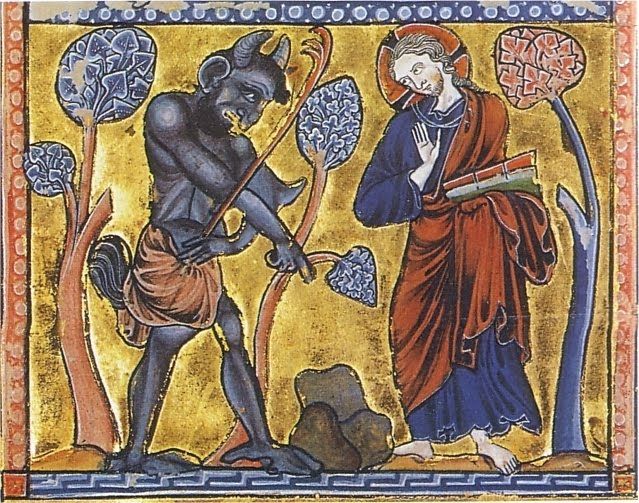
The tempter came to him and said, ‘If you are the Son of God, tell these stones to become bread.’
Jesus answered, ‘It is written: “Man shall not live on bread alone, but on every word, that comes from the mouth of God.”’ (Matthew 5:2-4)
Here Jesus is quoting Moses when he reminds the Israelites of how God protected, cared for and fed them after the exodus from Egypt. The passage also states that God humbled them by causing them hunger, ‘to test (you) in order to know what is in (your) heart. (Deuteronomy 8:1-5) and concludes with the principle of disciplining, teaching through both correction and encouragement – all through causing temptation and maintaining weakness; in other words, God could have removed the hunger pangs from the Hebrews – and from Jesus – but he chose to test the resolve of both to depend on him and his providence.
The next temptation for Jesus was a classic Satanic ploy that tests belief and truth, ‘if you are the son of God…’; Satan is exhorting Jesus to verify his sonship, when both Satan and Jesus already know the truth.

Then the devil took him to the holy city and set him on the highest point of the temple. ‘If you are the Son of God,’ he said, ‘throw yourself down. For it is written:
‘“He will command his angels concerning you,
and they will lift you up in their hands,
so that you will not strike your foot against a stone.”’
Jesus answered him, ‘It is also written: “Do not put the Lord your God to the test.”’ (ibid 5:5-7)
Again from Moses, the full quotation reads:
Do not put the Lord your God to the test as you did at Massah.
(Deuteronomy 6:16)
Now מַסָּה Massah (4532) is proper name that represents ‘a place of testing’. It is location in the Sinai desert past which the Hebrews travelled where the Hebrews ‘tested’ God ( נָסָה nasah ‘to test or try’ – Strong’s 5254 – but also ‘assay’, ‘tempt’ ‘venture’ or ‘prove’) by asking, ‘Is the Lord among us or not?’ God might test his people, but it is presumptuous for any to test Him.
The last temptation of Christ concerned Jesus’ own divinity and his complete authority. Satan offers what is not, and never will be, in his gift.

Again, the devil took him to a very high mountain and showed him all the kingdoms of the world and their splendour. ‘All this I will give you,’ he said, ‘if you will bow down and worship me.’
Jesus said to him, ‘Away from me, Satan! For it is written: “Worship the Lord your God, and serve him only.” (ibid 5:8-10)
Thus, Jesus dismisses Satan from his presence, once more employing the words of Moses.
But these three temptations were not the limit of Jesus’ testing. His divinity, far from protecting him from his human weakness, rather exposed him to every single enticement to sin known to humankind; indeed, this was necessary if Jesus was to carry to the cross every sin ever committed for redemption to be universally offered.
As for the tribes of Israel whose desert sojourn lasted forty years, and for Jesus’ forty days, so with each follower of Christ, God will test in order to discipline, but only for the chance of betterment – and certainly not to punish (Paul states that ‘there is no condemnation in Christ Jesus’ – Romans 8:1). Therefore, no test or temptation is random, spiteful or meaningless, as it is initiated, if not delivered, by God. This leads Paul to
‘delight in weaknesses, in insults, in hardships, in persecutions, in difficulties’ (2 Corinthians 12:10).
So, trials and temptations are Biblically synonymous as they are both a divine process of improvement – even that of the trial of suffering adversity:
Not only so, but we also glory in our sufferings, because we know that suffering produces perseverance; perseverance, character; and character, hope. (Romans 5:3-4)
In truth, the follower of Christ suffers the discipline of God through test, temptation and trail.
In your struggle against sin, you have not yet resisted to the point of shedding your blood. And have you completely forgotten this word of encouragement that addresses you as a father addresses his son? It says,
‘My son, do not make light of the Lord’s discipline,
and do not lose heart when he rebukes you,
because the Lord disciplines the one he loves,
and he chastens everyone he accepts as his son.’
Endure hardship as discipline; God is treating you as his children. For what children are not disciplined by their father? If you are not disciplined – and everyone undergoes discipline – then you are not legitimate, not true sons and daughters at all. Moreover, we have all had human fathers who disciplined us and we respected them for it. How much more should we submit to the Father of spirits and live! They disciplined us for a little while as they thought best; but God disciplines us for our good, in order that we may share in his holiness. No discipline seems pleasant at the time, but painful. Later on, however, it produces a harvest of righteousness and peace for those who have been trained by it. (Hebrews 12:4-11)
The prayer Jesus gave the world (Matthew 6:9-13), contains the line, ‘lead us not into temptation’; here Jesus is not asking God to spare any from his trials, as it cannot be separated from the following line (that is not recorded in Luke’s version) ‘but deliver us from evil’ (or ‘the evil one’). Jesus is asking that all that offer this prayer endure the trail by not yielding to temptation.
It is no easy thing, then, to follow of Christ and be ready to obey God’s will and be tested as He so desires and for His express purposes; but it helps to trust that:
No temptation has overtaken you except what is common to mankind. God is faithful; he will not let you be tempted beyond what you can bear. But when you are tempted, he will also provide a way out so that you can endure it. (1 Corinthians 10:13)
And the follower can also legitimately ask that God for help, in his or her weakness, not to bring temptation upon himself. Praying as David:
Incline not my heart to any evil thing, to practice wicked works with the workers of iniquity. (Psalm 141:4)
 God Breathed Words