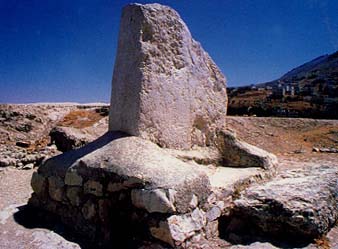
‘Now fear the Lord and serve him with all faithfulness. Throw away the gods your ancestors worshipped beyond the River Euphrates and in Egypt, and serve the Lord. But if serving the Lord seems undesirable to you, then choose for yourselves this day whom you will serve, whether the gods your ancestors served beyond the Euphrates, or the gods of the Amorites, in whose land you are living.’ (Joshua 24:14-15)
Joshua was tasked with leadership. He successfully established the tribes of Israel in the land promised to them, through God’s covenant with Abraham. His last act as leader was to call the Israelites to Shechem to warn them about falling away from God and to make a new covenant ‘to reaffirm the laws and decrees’ (v.25). He erected a stone as a witness (v27).

The Hebrew verb בָּחַר bachar (Strong’s 977), ‘to choose’ is often used in connection with God’s choice, for instance Deuteronomy 4:37. Word search ‘choice’ in any concordance and most references are in regard of God choosing men, not men choosing God.
But choice itself is God-given; it is the ultimate expression of the free will that God grants humankind; while with Israel the choice was collective, under the grace of the New Covenant, choices are personal; they come to define each individual and the nature of their eternity.
A cursory check should help to elucidate this point. A person’s appearance, sexuality and gender is given by His will. God grants to each intellect, rationality and personality. There is no point in boasting or taking credit for one’s good looks, athleticism or cleverness. If an author writes a book, beyond the application of time and effort, there is little of which to boost, as even inspiration is, as the word implies, ‘spiritual’.
The only thing that any person can claim as theirs is the choices they make; and these are binary: doing God’s will, that is choosing God, or sinning, rejecting God. There is no mid-ground or ‘grey’ area.
It is also a defining trait of men and women that they take God-given autonomy and seek to serve themselves; therefore, narcissism is the outworking of sin.
Apart from Christ, of course, a man or woman has no choice but to be narcissistic, even his or her philanthropy derives from their own choice over what is good or bad, or deserving or undeserving. There is no reference to God. That said , there is conscience. None can escape entirely from the imprint of God’s image; everyone knows right from wrong.
In Christ, there is choice and the Holy Spirit is sent to help make plain the choices. The regenerate man or woman is alive to God’s will and thenceforth can choose to walk away from sin (repent). Jesus also makes this as straightforward and as unambiguous as possible, by giving simple commandments.
Blessed are those who keep his statutes
and seek him with all their heart –
they do no wrong
but follow his ways. (Psalm 119:2-3)
And those Godly choices help to build character, because choosing to serve God will meet with opposition. Paul writes:
we also glory in our sufferings, because we know that suffering produces perseverance; perseverance, character; and character, hope. (Romans 5:3-4)
Character, therefore, is a shared work that underpins hope; but it is for each person about making the correct choices. The first is to have faith in Jesus as Lord, thereby to benefit from his saving grace, but thereafter to build upon this foundation a lasting work that will gain eternal reward:
For no one can lay any foundation other than the one already laid, which is Jesus Christ. If anyone builds on this foundation using gold, silver, costly stones, wood, hay or straw, their work will be shown for what it is, because the Day will bring it to light. It will be revealed with fire, and the fire will test the quality of each person’s work. If what has been built survives, the builder will receive a reward. (1 Corinthians 3:11-14)
But if any fail to avail themselves of Christ and his sacrifice, the warning is stark:
Then they will call to me but I will not answer;
they will look for me but will not find me,
since they hated knowledge
and did not choose to fear the Lord. Proverbs 1:28-29
And Jesus warns not many will make that choice:
‘Enter through the narrow gate. For wide is the gate and broad is the road that leads to destruction, and many enter through it. But small is the gate and narrow the road that leads to life, and only a few find it. Matthew 7:13-14
Furthermore, there is no alternative on offer.
When in Milton’s Paradise Lost, Satan utters, ‘better to rule in Hell than serve in Heaven’, he deceives himself. Hell is not an alternate universe or realm outside of God’s compass. There is only a state of being from which God withdraws his communion. Jesus cautions this, the true death, too awful to contemplate. Whence the ‘broad gate’ leads must be constantly preached – it is not a choice that any should desire, or make by default.
It is, of course, no coincidence that Joshua and Jesus share the same name, Yehoshua, meaning ‘salvation’. Both offer a choice, Yehoshua ben Nun to the Israelites as a tribe; Yehoshua (ben Dovid) to every person that advances salvation and blessing over condemnation and death.

 God Breathed Words