
For we know that if the earthly tent we live in is destroyed, we have a building from God, an eternal house in heaven, not built by human hands. (2 Corinthians 5:1)
It is apposite that Paul should use a tent as a metaphor for the mortal body, as he was himself a tentmaker, making the ubiquitous black tents, still seen today across the Middle East. The Greek word that here is translates tent is σκῆνος skenos (Strong’s 4636) and can mean tent or tabernacle (the tent of the meeting in Exodus that houses the Arc of the Covenant and God’s presence.)
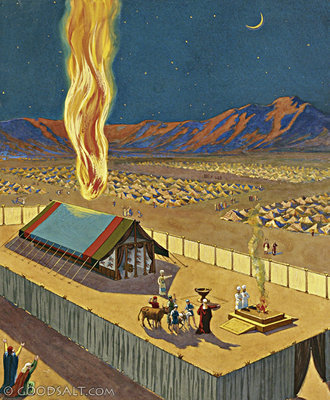
John speaks of Jesus being ‘tabernacled’ (σκηνόω skenoo; Strongs 4637, to dwell in a tent or encamp) amongst mankind:
The Word became flesh and made his dwelling among us. (John 1:14).
Peter uses a similar word…
I think it is right to refresh your memory as long as I live in the tent of this body, because I know that I will soon put it aside, as our Lord Jesus Christ has made clear to me. (2 Peter 1:13-14)
…σκήνωμα skenoma (Strong’s 4638) meaning a pitched tent, but the analogy is the same. And it is metaphor that serves fully. The tent is an outer protection from the elements, yet it is a temporary structure, taken down and rebuilt at will, much like the mortal body for the immortal is by God’s will.
Understandably, Jesus’ teaching concentrated on this life and how to live it in a Godly manner. But by his death and resurrection, he gives us the greatest of all signs and wonders, eternal life.
After purging the temple, Jesus was challenged by the Sanhedrin.
The Jews then responded to him, ‘What sign can you show us to prove your authority to do all this?’
Jesus answered them, ‘Destroy this temple, and I will raise it again in three days.’
They replied, ‘It has taken forty-six years to build this temple, and you are going to raise it in three days?’ But the temple he had spoken of was his body. After he was raised from the dead, his disciples recalled what he had said. Then they believed the Scripture and the words that Jesus had spoken. (John 2:18-20)
This was the sign of Jonah (Matthew 12:39) and this was brought in accusation against him (Mark 14:58) at his trial.
Without revelation that came through the Spirit after Pentecost, no one understood that Jesus spoke of resurrection; after all, it was fantastical, unthinkable. But Jesus offered more still, that through faith all can share in his resurrection.
In taking sin upon himself, he offers healing:
He himself bore our sins’ in his body on the cross, so that we might die to sins and live for righteousness; ‘by his wounds you have been healed. (1 Peter 2:24)
But healing mean being made whole, restored to God. When Jesus put sin to death, he created eternal life in body free from all corruption.
Paul writes using the rhetorical proposition:
For if we have been united with him in a death like his, we will certainly also be united with him in a resurrection like his. For we know that our old self was crucified with him so that the body ruled by sin might be done away with, that we should no longer be slaves to sin – because anyone who has died has been set free from sin.
Now if we died with Christ, we believe that we will also live with him. For we know that since Christ was raised from the dead, he cannot die again; death no longer has mastery over him. The death he died, he died to sin once for all; but the life he lives, he lives to God. In the same way, count yourselves dead to sin but alive to God in Christ Jesus.
(Romans 6:5-11)
And as Paul says, all have a sense of this new life, and yearn for it – even if people mistake this for a temporal promise:
….we groan, longing to be clothed instead with our heavenly dwelling, because when we are clothed, we will not be found naked. For while we are in this tent, we groan and are burdened, because we do not wish to be unclothed but to be clothed instead with our heavenly dwelling, so that what is mortal may be swallowed up by life. Now the one who has fashioned us for this very purpose is God, who has given us the Spirit as a deposit, guaranteeing what is to come. (2 Corinthians 5:2-5)
Thus transformation begins at justification, but critically this is not for the benefit alone of those regenerated:
Therefore, if anyone is in Christ, the new creation has come: the old has gone, the new is here! All this is from God, who reconciled us to himself through Christ and gave us the ministry of reconciliation: that God was reconciling the world to himself in Christ, not counting people’s sins against them. And he has committed to us the message of reconciliation. We are therefore Christ’s ambassadors, as though God were making his appeal through us. (ibid 5:17-20)
Ambassadors are representatives sent by a king. With regeneration, therefore, comes the responsibility to tell others the Gospel of hope and life.
Part of this message, then, concerns the assurance of personal resurrection, but many Christians do not seek an understanding of this. The Bible provides enough for any to be truly excited, something to be desired and eagerly anticipated.
(Jesus) who, by the power that enables him to bring everything under his control, will transform our lowly bodies so that they will be like his glorious body. (Philippians 3:20-21)
Of course, the resurrected Jesus is the best (indeed so far, the only) exemplar of this new body. The first sighting of his resurrected form is by Mary Magdalene:
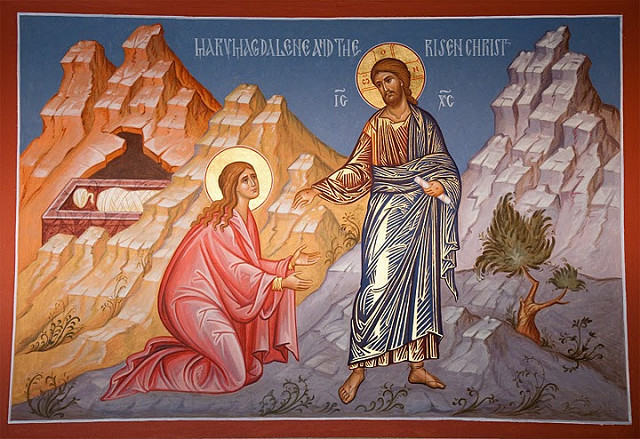
She saw Jesus standing there, but she did not realise that it was Jesus.
He asked her, ‘Woman, why are you crying? Who is it you are looking for?’
Thinking he was the gardener, she said, ‘Sir, if you have carried him away, tell me where you have put him, and I will get him.’
Jesus said to her, ‘Mary.’
She turned towards him and cried out in Aramaic, ‘Rabboni!’ (which means ‘Teacher’).
(John 20:14-16)
Clearly, Jesus is human in form and resembles his prior self. Initially, her eyes are clouded with tears and she does not recognise him – indeed, she expected to never see him again. Yet, those quite reasonable expectations are confounded and once he speaks, the recognition is complete. The voice is his.
Jesus is corporeal, but also spirit and therefore, not governed by the natural laws; nevertheless, his disciples can touch him and he eats to prove that he is no apparition.
Luke was a physician, and his account has the perspective of man of science. Locked in the upper room, Jesus materialises in front of the disciples:
They were startled and frightened, thinking they saw a ghost. He said to them, ‘Why are you troubled, and why do doubts rise in your minds? Look at my hands and my feet. It is I myself! Touch me and see; a ghost does not have flesh and bones, as you see I have.’ When he had said this, he showed them his hands and feet. And while they still did not believe it because of joy and amazement, he asked them, ‘Do you have anything here to eat?’ They gave him a piece of broiled fish, and he took it and ate it in their presence. (Luke 24:37-43)
And when Paul says that ‘flesh and blood cannot inherit the Kingdom of God’ (1 Corinthians 15:50) this is his way refers to the mortal body; he continues ‘nor does the perishable inherit the imperishable’. Also, immediately preceding in the chapter he says:
If there is a natural body, there is also a spiritual body. So, it is written: ‘The first man Adam became a living being’; the last Adam, a life-giving spirit. The spiritual did not come first, but the natural, and after that the spiritual. The first man was of the dust of the earth; the second man is of heaven. As was the earthly man, so are those who are of the earth; and as is the heavenly man, so also are those who are of heaven. And just as we have borne the image of the earthly man, so shall we bear the image of the heavenly man. (ibid 15:44-49)
The resurrection body is therefore ‘flesh and bone’; it is not ethereal or vaporous. It will be a body very like the mortal body in some respects, if not all. It is speculative, for instance, as to whether it will be sexual. Procreation is a result of the fall, and God’s creation is complete with the second advent of Christ. Jesus may hint at the asexuality of the resurrection body:
At the resurrection people will neither marry nor be given in marriage; they will be like the angels in heaven. (Matthew 22:30)
And as the church triumphant, all those resurrected are given as the collective bride of Christ.
But given that Adam and Eve were both made in God’s likeness, there is every reason to think each will recognise the other, gender characteristics notwithstanding. While this is open to conjecture, there is one sure promise about the resurrection body – it is indestructible. Paul writes of the wondrous:
Listen, I tell you a mystery: we will not all sleep, but we will all be changed – in a flash, in the twinkling of an eye, at the last trumpet. For the trumpet will sound, the dead will be raised imperishable, and we will be changed. For the perishable must clothe itself with the imperishable, and the mortal with immortality. When the perishable has been clothed with the imperishable, and the mortal with immortality, then the saying that is written will come true: ‘Death has been swallowed up in victory.’
‘Where, O death, is your victory?
Where, O death, is your sting?’ (ibid 15:51-55)
So, with the Parousia, those alive in Christ will be swap mortal flesh for immortal and all those that have died will be raised in new bodies.
The bodies of the living will be folded like tents and put away forever. It is (always) time for those who follow Jesus to speak openly of this ‘mystery’. As Paul tells Felix the Procurator ‘there will be a resurrection of both the righteous and the wicked’ (Acts 24:15), but all should note the resurrection body is not offered universally. In being witnesses to the resurrection, all in Christ should emulate Paul when he is brought, this time, before Agrippa:
I stand here and testify to small and great alike. I am saying nothing beyond what the prophets and Moses said would happen – that the Messiah would suffer and, as the first to rise from the dead, would bring the message of light to his own people and to the Gentiles. (Acts 26:22-23)
If any believe they will be resurrected along with Christ, then they should not be coy in declaring this fact, or vague in description. What can be more urgent and pressing than this day telling people they can have an eternal body that is without disease or decay through the grace of God, and by faith in Jesus as his Son?
 God Breathed Words