
God is faithful and keeps his promises – even when humankind cannot. To save his creation, he had to make a covenant and populate both sides of the agreement. Jesus was God made flesh to ensure God the Father had no cause for default, but the cost was the separation, expressed in the Cry of Dereliction. To understand this process, it best to look to the previous biblical covenants, only then will the radical design of the ‘New Covenant’ emerge.
I will sing of the Lord’s great love for ever;
with my mouth I will make your faithfulness known
through all generations.
I will declare that your love stands firm forever,
that you have established your faithfulness in heaven itself.
You said, ‘I have made a covenant with my chosen one,
I have sworn to David my servant,
“I will establish your line for ever
and make your throne firm through all generations.”’ (Psalm 89:1-4 NKJV)
The Old French word has not changed in spelling or basic meaning after being coined into English. It means ‘agreement’ (Latin coveniens, ‘agreeable’, ‘suitable’ – the root of ‘convenient’). But the use of the ‘covenant’ was mostly in law, where it meant committal. To make a covenant meant to offer a solemn undertaking, and so quickly become synonymous with a promise or pledge. Covenant now has the meaning of a binding agreement.
In the Bible, ‘covenant’ is used most often to express God’s inviolable promise to humankind, to be faithful when we are not. Psalm 89 is a hymn of praise to the covenant God declared to David:
In the same psalm, God is quoted stating:
I will establish his line for ever,
his throne as long as the heavens endure.
‘If his sons forsake my law
and do not follow my statutes,
if they violate my decrees
and fail to keep my commands,
I will punish their sin with the rod,
their iniquity with flogging;
but I will not take my love from him,
nor will I ever betray my faithfulness.
I will not violate my covenant
or alter what my lips have uttered…’ (ibid 89: 29-34)
Biblical covenants are bi-lateral agreements, in that is there are always two parties – in the above case, David and God – but they are not mutual, neither is the benefit equitable. Of the many divine covenants, all are proposed by God and all unconditional, just as with David where God’s promise is given without the need for reciprocation.
The exception is the Mosaic covenant. This is conditional. God proclaims a consequence for breaching the agreement, while also offering incentives to honour it. After the giving of the law, Moses speaks for God:
See, I am setting before you today a blessing and a curse – the blessing if you obey the commands of the Lord your God that I am giving you today; the curse if you disobey the commands of the Lord your God and turn from the way that I command you today by following other gods, which you have not known. (Deuteronomy 11:27-28)
Temporal destruction was the curse for disobedience but, unbeknownst to Moses, the law was to be fulfilled in Christ in order to grant eternal blessing.
For this to be done God had to inhabit both sides of the covenant, he would have to become a man, and represent humankind’s side of the compact. To make this comprehensible, God enacted this through a process, a ceremony to mark the compact.
The Hebrew word that is translated as ‘covenant’ is בְּרִית berith (Strong’s 1285. This word derives from barah, to eat – to feed – to give flesh or to choose or make manifest; bara’ cutting a compact made by passing between pieces of flesh (cut in two).
The process is described by Jeremiah, who is outlining God’s temporal curse for not keeping the Mosiac covenant:
Those who have violated my covenant and have not fulfilled the terms of the covenant they made before me, I will treat like the calf they cut in two and then walked between its pieces. The leaders of Judah and Jerusalem, the court officials, the priests and all the people of the land who walked between the pieces of the calf, I will deliver into the hands of their enemies who want to kill them. Their dead bodies will become food for the birds and the wild animals. (Jeremiah 34:18-20)
It seems then that the covenant of God was enacted through sacrifice and the parting of flesh. The parties would seal the covenant by walking between the two halves of a sundered animal.

Here with Abram:
So, the Lord said to him, ‘Bring me a heifer, a goat and a ram, each three years old, along with a dove and a young pigeon.’ Abram brought all these to him, cut them in two and arranged the halves opposite each other; the birds, however, he did not cut in half. Then birds of prey came down on the carcasses, but Abram drove them away…When the sun had set and darkness had fallen, a smoking brazier with a blazing torch appeared and passed between the pieces. On that day, the Lord made a covenant with Abram… (Genesis 15:9-11&17-18)
But there is one detail to note, Abram was not awake during the ceremony.
As the sun was setting, Abram fell into a deep sleep, and a thick and dreadful darkness came over him. (ibid 15:12)
This was the covenant over land, the promised land, but as all the other promises where God made him Abraham, the ‘father of nations’, we see God taking all the parts. His Spirit is represented by the fire that passed between the ‘pieces’.
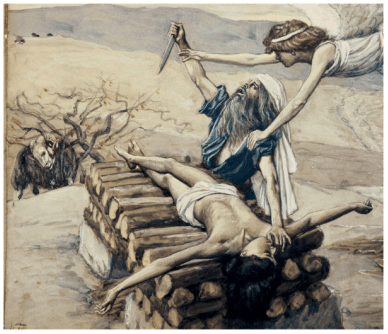
And, for further elucidation, there is the call to sacrifice his own son, Isaac, where once more God intervenes; he forbids Abraham and, in so doing, conserves the right to filicide to himself.
The revelation therefore is with Jesus and New Covenant. There is one God in three persons, so God the Son is the sacrifice of flesh and it is Jesus that is sundered from his Father in death, just like the halves of the animals, for Holy Spirit to pass to mankind.
Jesus fulfills the Law, but also embodies mankind as the other party, and because he is sinless, he can be the second party to God the Father.
Again Jeremiah:
‘The days are coming,’ declares the Lord,
’when I will make a new covenant
with the people of Israel
and with the people of Judah.
It will not be like the covenant
I made with their ancestors
when I took them by the hand
to lead them out of Egypt,
because they broke my covenant,
though I was a husband to them,’
declares the Lord.
‘This is the covenant that I will make with the people of Israel
after that time,’ declares the Lord.
‘I will put my law in their minds
and write it on their hearts.
I will be their God,
and they will be my people.
No longer will they teach their neighbour,
or say to one another, “Know the Lord,”
because they will all know me,
from the least of them to the greatest,’
declares the Lord.
‘For I will forgive their wickedness
and will remember their sins no more.’ (Jeremiah 31:31-34)
The Book of Hebrews shows that this the New Covenant, when the Spirit will be indwelling, although from the prophet’s perspective he does not distinguish between the first and second coming of Christ (after the cross, the Holy Spirit indwells and law is written on hearts but only after the second coming when mankind is judged and sin is no more and the righteous know God.)
By calling this covenant ‘new’, he (Jesus) has made the first one obsolete; and what is obsolete and outdated will soon disappear. (Hebrews 8:13)
God’s promises to mankind, through Adam, Noah, Abraham, Moses and David all concern redemption via Jesus, through his sacrifice comes righteousness and a way back for mankind to once more dwell in intimate communion with God.
As the writer of Hebrews reaches his conclusion, there is a benediction that is based in God’s promises:
Now may the God of peace, who through the blood of the eternal covenant brought back from the dead our Lord Jesus, that great Shepherd of the sheep, equip you with everything good for doing his will, and may he work in us what is pleasing to him, through Jesus Christ, to whom be glory for ever and ever. Amen (Hebrews 13:20-21)
 God Breathed Words