Hell is not a subject for polite conversation. Surely, in these modern times, free of superstition, the concept of eternal damnation is not only offensive but ludicrous? Of course, for any that are atheist, Hell has no meaning. But for the Christian, on what do they base this assessment of irrelevance? If the Bible is wrong on Hell, then how is ‘right’ on Heaven or Paradise? Some Christians avoid speaking about Hell, while others deny Jesus’ teaching on the subject. In this post, I examine what the Bible has to say about Hell.
Do not be afraid of those who kill the body but cannot kill the soul. Rather, be afraid of the One who can destroy both soul and body in hell. (Matthew 10:28)
The word translated hell is γέεννα geenna (Strong’s 1067) and it refers to Gehenna, or Gehinnom, ‘the valley of Hinnom’, a small valley near to Jerusalem, which was a perpetually burning rubbish-tip.
In describing the land allotted to the tribe of Judah, Joshua says of its boundary:
Then it ran up the Valley of Ben Hinnom along the southern slope of the Jebusite city – that is, Jerusalem… (Joshua 15:8)
Thus, the name is properly הִנֹּ֗ם בֶן־ ‘the valley of the son of Hinnom’.
But by Jeremiah’s time, the valley’s name had been associated with the heinous practice of child sacrifice.
‘“The people of Judah have done evil in my eyes, declares the Lord. They have set up their detestable idols in the house that bears my Name and have defiled it. They have built the high places of Topheth in the Valley of Ben Hinnom to burn their sons and daughters in the fire – something I did not command, nor did it enter my mind. So beware, the days are coming, declares the Lord, when people will no longer call it Topheth or the Valley of Ben Hinnom, but the Valley of Slaughter, for they will bury the dead in Topheth until there is no more room… (Jeremiah 7:30-32)
Jesus uses this analogy to convey a place of punishment as bodies would be cast onto the smouldering to be consumed by fire or scavenging wild dogs.
The Hebrew understanding of the afterlife was very different to this, שְׁאוֹל
Sheol was like Hades, was the abode where disembodied spirits resided. It was not a place of punishment, nor was it a destination of the wicked following judgement. The Tanakh seems to speak of it almost as a kind of limbo, if not one in which sins are outworked, but where souls look forward to the coming of one who will ransom them from the underworld:
Truly no man can ransom another,
or give to God the price of his life,
for the ransom of their life is costly
and can never suffice,
that he should live on forever
and never see the pit…
Like sheep they are appointed for Sheol;
death shall be their shepherd,
and the upright shall rule over them in the morning.
Their form shall be consumed in Sheol, with no place to dwell.
But God will ransom my soul from the power of Sheol,
for he will receive me. (Psalm 49:7-9 & 14-15)
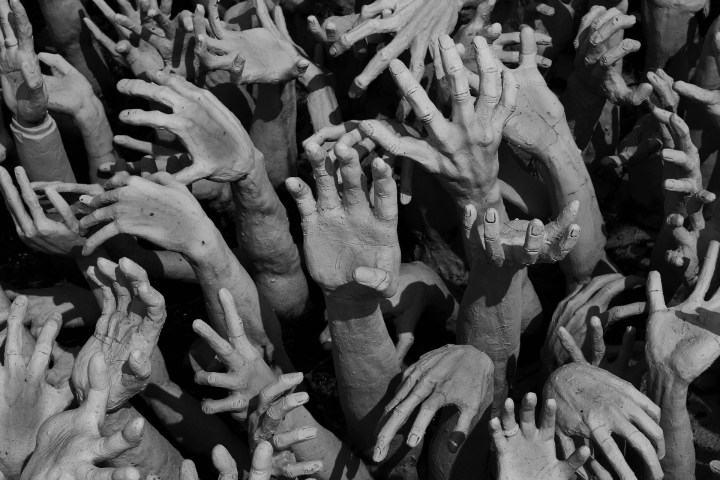
Hell was originally a direct translation for Sheol or Hades. The Old English hel meant a dark place, and as such associated with being underground. It could mean a cellar or pit but no particular associations with dead spirits, and certainly not endless torment. In its neutrality, helhas more in common with Sheol the lower world (netherworld). In the Anglo-Saxon translation, Numbers 16:33, ‘they went down alive into the realm of the dead’ reads: hig intó helle cuce síðodon.
The full passage (vs 31 – 34) gives the context:
As soon as he finished saying all this, the ground under them split apart and the earth opened its mouth and swallowed them and their households, and all those associated with Korah, together with their possessions. They went down alive into the realm of the dead,with everything they owned; the earth closed over them, and they perished and were gone from the community. At their cries, all the Israelites around them fled, shouting, ‘The earth is going to swallow us too!’
There are then two distinct understandings of the afterlife, there is place where souls reside to await judgement (Sheol or Hades) and then there is the destination of those who suffer the second death, those who dies in their sin having rejected Jesus and his substitutionary sacrifice, which has come to be known as Hell.
The sea gave up the dead that were in it, and death and Hades gave up the dead that were in them, and each person was judged according to what they had done. Then death and Hades were thrown into the lake of fire. The lake of fire is the second death. Anyone whose name was not found written in the book of life was thrown into the lake of fire. (Revelation 20:13-15)
Scripture frequently speaks of fire, but this may not be an attempt to convey the concept of eternal damnation through metaphor, there is no reason to not take this literally, especially as Jesus speaks only truth:
‘But I tell you that anyone who is angry with a brother or sisterwill be subject to judgment. Again, anyone who says to a brother or sister, “Raca,”is answerable to the court. And anyone who says, “You fool!” will be in danger of the fire of hell.’ (Matthew 5:22)
‘The Son of Man will send out his angels, and they will weed out of his kingdom everything that causes sin and all who do evil. They will throw them into the blazing furnace, where there will be weeping and gnashing of teeth.’ (ibid 13:41-42)
‘And if your eye causes you to stumble, pluck it out. It is better for you to enter the kingdom of God with one eye than to have two eyes and be thrown into hell, where
‘“the worms that eat them do not die,
and the fire is not quenched.”’ (Mark 9:47-48)
The quotation is of the very last verse from the prophesy of Isaiah (66:24) in context it reads:
‘As the new heavens and the new earth that I make will endure before me,’ declares the Lord, ‘so will your name and descendants endure. From one New Moon to another and from one Sabbath to another, all mankind will come and bow down before me,’ says the Lord. ‘And they will go out and look on the dead bodies of those who rebelled against me; the worms that eat them will not die, the fire that burns them will not be quenched, and they will be loathsome to all mankind.’ (Isaiah 66:22-24)
Weeping, gnashing teeth and fire are frequent images of hell that Jesus employs; moreover, this is a destination with no return:
‘Then he (the King) will say to those on his left, “Depart from me, you who are cursed, into the eternal fire prepared for the devil and his angels…”’
‘Then they will go away to eternal punishment, but the righteous to eternal life.’ (Matthew 25:41& 46)
Jesus teaches hell, and Scripture provides example to augment his words:
Sodom and Gomorrah and the surrounding towns gave themselves up to sexual immorality and perversion. They serve as an example of those who suffer the punishment of eternal fire. (Jude 7)
And yet, people still do not listen. And in it is not only those who reject Christ, some Christians choose to deny the very existence of eternal damnation by claiming annihilation over torment, while others believe that all will be saved at the Judgement Seat. But whether annihilation or universalism, Jesus does not teach this; and to depart from Scripture has fatal consequences. Not only does the false teacher stand condemned, but any that our led astray may find out the existence of Hell when it is too late.
There can be no doubt that if anyone could conceive of this eternal prospect, none would dare sin. Even a moment spent in Hell, or a fleeting vision of it, surely that would that be enough? Surely God cannot expect any to pay the price of rebellion without a full comprehension of the eternal cost?
Men and women will assert that is not fair for God to hold any to account in such circumstances, but playing fair is playing by their own rules. However, God sets the rules, and as He is morally perfect, any consequence for transgression is just.
In the Garden of Eden, God demanded the same of Adam as he does of humankind today, to listen and obey through trusting his sovereign purpose:
…the Lord God commanded the man, ‘You are free to eat from any tree in the garden; but you must not eat from the tree of the knowledge of good and evil, for when you eat from it you will certainly die.’ (Genesis 2:16-17)
Could Adam understand the full consequences of disobedience? Could he conceive of decrepitude and death, the horror of disease or toiling for his livelihood? His helpmate had yet to be created, so how could he possibly imagine the gulf that would be placed between men and women after the Fall? Did he know that allcreation would be cursed after his fatal trespass? No to all the above, but Adam wasgiven ‘fair’ warning, in fact, a just warning.
Furthermore, what if God is explicit? Does Scripture attest to a different outcome?
When the Israelites are about to enter the promised land, Moses reiterates the Law God entrusted to him and bears his name תֹּורַת מֹשֶׁהTorat Moshe. Having reminded Israel, he also details the blessings the nation can expect if they fully obey God’s commandments. While the blessings should have been enough – because the Promised Land sounds like a redeemed Eden – the prophet also provides the negative consequences of rebellion for lack of compliance. While the blessings are delivered in ten verses, the manifold curses run to forty-two; moreover, they are extensive and harrowing in their detail – here is a selection:
The fruit of your womb will be cursed, and the crops of your land, and the calves of your herds and the lambs of your flocks.(Deuteronomy 28:18)
The Lord will strike you with wasting disease, with fever and inflammation, with scorching heat and drought, with blight and mildew, which will plague you until you perish.(ibid 28:22)
You will become a thing of horror, a byword and an object of ridicule among all the peoples where the Lord will drive you.(ibid 28:37)
Because of the suffering your enemy will inflict on you during the siege, you will eat the fruit of the womb, the flesh of the sons and daughters the Lord your God has given you.(ibid 28:53)
…you will serve the enemies the Lord sends against you. He will put an iron yoke on your neck until he has destroyed you.(ibid 28:48b)
God delivered Canaan to the Israelites, but soon they forgot his warnings and decided, like Adam that they could better paradise.
Throughout history beginning with Adam, God gives clear warning about the consequence of sin. Faith is believing him to speak the truth. Adam had not experienced death, but knew it to be something not to be desired. The Israelites had never enjoyed freedom and knew what it was to be enslaved, yet the promised curse of an ‘iron yoke’ was not sufficient to keep them from disobedience and idolatry. Likewise, all today have been given a glimpse of Hell, if only through war, disease and famine.
Thus, before the judgement seat of Christ, no man or woman will ever have the defence of not grasping the consequences of rejecting Jesus and living an idolatrous life. That we lack full experiential knowledge of the penalty is not an excuse that works even within common law, let alone inside the divine court.
Hence, there is only one question left, does God keep his word? And the only answer is, always. Though none have experienced Hell, doubting God cannot be offered to Jesus in mitigation of damnation, any more than a failure of imagination. When Paul exhorts the discouraged to focus on the eternal he would have them look to the blessing of salvation.
For our light and momentary troubles are achieving for us an eternal glory that far outweighs them all. So, we fix our eyes not on what is seen, but on what is unseen, since what is seen is temporary, but what is unseen is eternal.(2 Corinthians 4:17-18)
This is hope and Biblical hope is more than a wish, but a confident expectation.
For in this hope we were saved. But hope that is seen is no hope at all. Who hopes for what they already have? But if we hope for what we do not yet have, we wait for it patiently. (Romans 8:24-25)
As men and women hope in the direction of what we fear, all should fear Hell and seek to be saved from it. But to those that choose to deny God can hope of an eternity without him, but it will not be a pleasant alternative. The occupants of Hell will spend an eternity not just in regret but also anguish, and Jesus would have us know this through speaking the plain and unvarnished truth regarding the Lake of Fire.
 God Breathed Words