If faith is commitment before knowledge, then doubt is inevitable. The most famous of doubters is Thomas the twin, one of Jesus’s disciples, but John the Baptist also came to doubt Jesus as the Christ. How given his own anointing could he doubt? In this post, I examine, doubt, where it arises and how it is part of faith.
If any of you lacks wisdom, you should ask God, who gives generously to all without finding fault, and it will be given to you. But when you ask, you must believe and not doubt, because the one who doubts islike a wave of the sea, blown and tossed by the wind. That person should not expect to receive anything from the Lord. Such a person is double-minded and unstable in all they do. (James 1:5-8)
The word translated ‘doubt’ is the verb διακρίνω diakrino (Strong’s 1252) from dia ‘going back and forth’, ‘going through’ and krino to ‘judge’; this has a positive sense, as in English, to doubt is to use one’s faculties to discern, but also, as here in James, that it can represent wavering and hesitancy. To doubt the revelation of God, James declares, it to remain ‘unsettled’, blown hither and thither with no anchorage. The context is asking for and receiving wisdom, but doubt can occur in any circumstances.
Living with doubt is a reality for many Christians, none with more apparent blessings than John the Baptist.
John gave witness to Jesus even before he was born. The angel told Mary that her relative*, Elizabeth, was her sixth month with child:
At that time, Mary got ready and hurried to a town in the hill country of Judea, where she entered Zechariah’s home and greeted Elizabeth. When Elizabeth heard Mary’s greeting, the baby leaped in her womb, and Elizabeth was filled with the Holy Spirit. In a loud voice, she exclaimed: ‘Blessed are you among women, and blessed is the child you will bear! But why am I so favoured, that the mother of my Lord should come to me? As soon as the sound of your greeting reached my ears, the baby in my womb leaped for joy. Blessed is she who has believed that the Lord would fulfil his promises to her!’ (Luke 1:39-45)
As his namesake, the Evangelist, writes:
There was a man sent from God whose name was John. He came as a witness to testify concerning that light, so that through him all might believe. He himself was not the light; he came only as a witness to the light. (John 1:6-8)
John’s certainty of his God-given role to be the witness of Jesus as the Messiah extended from the womb into manhood; uniquely (excluding Jesus) he was the only man to apply prophesy to himself.
Now this was John’s testimony when the Jewish leaders in Jerusalem sent priests and Levites to ask him who he was. He did not fail to confess, but confessed freely, ‘I am not the Messiah.’
They asked him, ‘Then who are you? Are you Elijah?’
He said, ‘I am not.’
‘Are you the Prophet?’
He answered, ‘No.’
Finally, they said, ‘Who are you? Give us an answer to take back to those who sent us. What do you say about yourself?’
John replied in the words of Isaiah the prophet, ‘I am the voice of one calling in the wilderness, “Make straight the way for the Lord.”’(John 1:19-23)
John the Baptist was sure of his role and purpose as a witness. He too was to witness the Father’s anointing of His Son:
‘I saw the Spirit come down from heaven as a dove and remain on him. And I myself did not know him, but the one who sent me to baptise with water told me, “The man on whom you see the Spirit come down and remain is the one who will baptise with the Holy Spirit.” I have seen and I testify that this is God’s Chosen One. (John 1:32-34)
But doubt was also part of the witness, despite knowing Jesus as an unborn, and presumably whilst growing up in the extended family:
… John saw Jesus coming towards him and said, ‘Look, the Lamb of God, who takes away the sin of the world! This is the one I meant when I said, “A man who comes after me has surpassed me because he was before me.” I myself did not know him, but the reason I came baptising with water was that he might be revealed to Israel.’ (ibid 1:29-31)
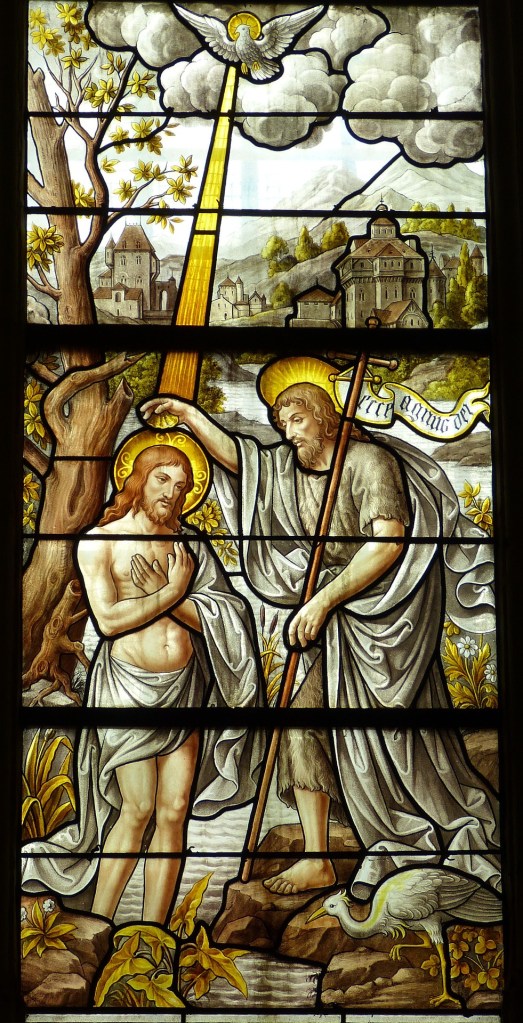
How did John not know Jesus? Not as a relative but as the Messiah. But then John’s doubt had extended to his own role in Jesus’ baptism:
Then Jesus came from Galilee to the Jordan to be baptised by John.
But John tried to deter him, saying, ‘I need to be baptised by you, and do you come to me?’
Jesus replied, ‘Let it be so now; it is proper for us to do this to fulfil all righteousness.’ Then John consented. (Matthew 3:13-15)
Divisions grew amongst John’s own disciples. One dispute was over who should baptise:
An argument developed between some of John’s disciples and a certain Jew over the matter of ceremonial washing. They came to John and said to him, ‘Rabbi, that man who was with you on the other side of the Jordan – the one you testified about – look, he is baptising, and everyone is going to him.’(John 3:24-26)
Yet at this point, John’s endorsement was unwavering, fully proclaiming Jesus’ supremacy:
He must become greater; I must become less. (ibid 3:30)
But after John’s arrest for speaking out against Herod’s incestuous marriage with Herodias (Matthew 14:3-4), his own doubts seem to fall in line with his disciples.
It seemed that Jesus was not meeting expectations. Luke chapter 7 records the restoration of the centurion’s servant from near death and the raising of widow’s son in Nain. Ministering to gentiles and widows appears to have given John pause for thought for when his disciples told him, he sent them to gain clarification.
John’s disciples told him about all these things. Calling two of them, he sent them to the Lord to ask, ‘Are you the one who is to come, or should we expect someone else?’
When the men came to Jesus, they said, ‘John the Baptist sent us to you to ask,
“Are you the one who is to come, or should we expect someone else?”’ (Luke 7:18-20)
But there had been earlier inquiries – this about fasting:
John’s disciples came and asked him, ‘How is it that we and the Pharisees fast often, but your disciples do not fast?’ (Matthew 9:14)
Also, indications that John was not approving of Jesus associating with sinners – commenting on the comments themselves, Jesus remarks:
For John came neither eating nor drinking, and they say, “He has a demon.” The Son of Man came eating and drinking, and they say, “Here is a glutton and a drunkard, a friend of tax collectors and sinners.” But wisdom is proved right by her deeds.’ (Matthew 11:18-19)
John seemed to be asking, was this Jesus just another in a long line of false Messiah’s? Apparently, Jesus did not measure up to John’s standards. Like for many of his nation, Jesus was not the model of the conquering King who would sweep away rule Gentile and all the unrighteous.
As John awaited his death in Herod’s prison, enduring appalling conditions, possibly only being fed by his followers, his faith was tested. It caused him to doubt his own testimony of Jesus’ Messiahship. Perhaps, he felt abandoned by Jesus? Maybe, he pleaded for miraculous intervention, similar to that which blessed Peter after Jesus’ death (Acts 12); however, this was not part of God’s purpose and subsequently John was beheaded at the behest of Herodias.
If John could come to doubt, with all the evidence of fulfilled prophesy, miraculous events and direct, personal knowledge, then it is possible for any follower to doubt. Indeed, just as faith is heaven sent (Ephesians 2:8-9) then so is doubt, it seems to test that faith.
As the Christian progresses in his walk, doubts arise. Perhaps there are less charismatic events or, maybe, the feelings of ‘first love’ fade. God would have all walk by faith, not by signs and feelings. Faith then is a decision to trust God, even against the evidence of one’s life. Languishing in jail, certain of a gruesome fate, John, son of Zechariah, was tested sorely. Other purposes were surely served by this, but one is that his fate is an example to any who waver when matters do not go as expected. Jesus will always fail to meet expectations of an unrepentant, earth-bound mind; the challenge is to seek Him not and have expectations confounded. Jesus continues to surprise, shake and overturn his followers, for those open to His ministry. The question must always be, how do I meet Jesus’ expectations, not does Jesus meet mine? Enacted faith, in other words, trust in his teaching is required, but all are free to doubt.
*Mary was from the tribe of Judah, but Elizabeth is called a descendent of Aaron, making her a Levite. The relationship is more likely to have been of blood, her father may have married a woman of Judah, than one by marriage.
 God Breathed Words