The word of God came to John son of Zechariah in the wilderness. He went into all the country around the Jordan, preaching a baptism of repentance for the forgiveness of sins. (Luke 3:2-3)
The Greek word translated baptism is βαπτίζω baptizó.
Baptism, then, is a straight transliteration from the Greek verb baptizó,which means to dip or immerse, especially associated with ceremonial or ritual acts. Ritual cleansing was associated with divine intervention, even among the Greeks. For instance, The Pool of Bethesda was sited outside the walls of Jerusalem and was an aσκληπιεῖον asklepeion a pool dedicated toAsclepius, the Greek god of medicine. It would have been established during the Hellenistic period of Judea.
Now there is in Jerusalem near the Sheep Gate a pool, which in Aramaic is called Bethesda and which is surrounded by five covered colonnades. Here a great number of disabled people used to lie – the blind, the lame, the paralysed. (John 5:2-3)
The next verse is omitted in some versions:
‘ From time to time an angel of the Lord would come down and stir up the waters. The first one into the pool after each such disturbance would be cured of whatever disease they had…
These was a blend of pagan and Jewish tradition, a folk-tale. The man whom Jesus cured was not quick enough to beat others into the water.
‘Sir,’ the invalid replied, ‘I have no one to help me into the pool when the water is stirred. While I am trying to get in, someone else goes down ahead of me.’ (ibid 5:7)
There were many such pools around Jerusalem, the Pool of Siloam was another, and the use of such natural pools close to springs predated the Greeks, as ritual cleansing or bathing was required under the Law.
For men:
‘When a man has an emission of semen, he must bathe his whole body with water, and he will be unclean till evening…’ (Leviticus 15:16)
For men and women:
‘When a man has sexual relations with a woman and there is an emission of semen, both of them must bathe with water, and they will be unclean till evening…’(ibid 15:18)
For women following menstruation (ibid 15:19-21) and irregular discharge (25-30).
If pools were not available, settled Israelite communities established a ritual bath, usually dug into the rock. Such a bath was called the mikvehand tradition established that it must hold 40 ‘seah’ of water, roughly equivalent to 140 gallons (530 litres).
They were designed to have the depth and capacity for a person to fully immersed as the Law required.
Ritual bathing was among the ways of ridding oneself of uncleanness but clearly this is not simply about washing and hygiene.
The Hebrew word for unclean (as used in Leviticus 15) is טָמֵא tame, it is verb that means ‘to be or become defiled’, and although there is no suggestion, that for instance, seminal emission, the sexual act (within the sanctity of marriage) or menstruation is sinful, defilement is nonetheless related to sin. This is seen no better than in the ritual for the High Priest on Yom Kippur, The Day of Atonement, which follows directly after the above requirements in Leviticus.
Moses is told by God to direct his brother Aaron in augurating the holy convocation, and instructs him with exhaustive detail on the ritual that will offering a covering for the sin of the Israelites. In amongst the directions is the need for cleansing:
‘This is how Aaron is to enter the Most Holy Place: he must first bring a young bull for a sin offering and a ram for a burnt offering. He is to put on the sacred linen tunic, with linen undergarments next to his body; he is to tie the linen sash round him and put on the linen turban. These are sacred garments; so he must bathe himself with water before he puts them on…’ (ibid 16:3-4)
Note, the cleansing medium is blood as well are water:
He shall sprinkle some of the blood on it with his finger seven times to cleanse it and consecrate it from the uncleanness of the Israelites. (ibid 16:19)
The word uncleanness translates the feminine noun טֻמְאָה tum’ah and is thus related to ‘defile’, that which is defiled.
Ridding the nation of uncleanness and defilement was the result of the process of atonement, but the covering was time-limited, thus it would need to be an annual ritual:
‘This is to be a lasting ordinance for you: on the tenth day of the seventh month you must deny yourselves and not do any work – whether native-born or a foreigner residing among you – because on this day atonement will be made for you, to cleanse you. Then, before the Lord, you will be clean from all your sins…’(ibid 16: 29-30)
God decreed that immersion of water and blood would be necessary to be clean, to be righteous.
All this is a forerunner, the prelude to Jesus who fulfils the Law in this (as in all ways – Matthew 5:17) as the writer of Hebrews elucidates:
The blood of goats and bulls and the ashes of a heifer sprinkled on those who are ceremonially unclean sanctify them so that they are outwardly clean. How much more, then, will the blood of Christ, who through the eternal Spirit offered himself unblemished to God, cleanse our consciences from acts that lead to death, so that we may serve the living God! (Hebrews 9:13-14)
The Law was regarding purification was strictly observed in Jesus’ day. The disciples would have visited the mikveh in preparation for the Passover – this might explain Peter’s confusion when Jesus offered to wash his feet.
Misunderstanding the enactment of humility for ritual purification, Peter thought he needed to be washed all over again.
‘No,’ said Peter, ‘you shall never wash my feet.’
Jesus answered, ‘Unless I wash you, you have no part with me.’
‘Then, Lord,’ Simon Peter replied, ‘not just my feet but my hands and my head as well!’
Jesus answered, ‘Those who have had a bath need only to wash their feet; their whole body is clean. And you are clean…’ (John 13:8-10)
Peter had already been baptised.
But if the use of the mikveh was commonplace, baptism in open water was unusual for Jews and this practice did not arrive with Jesus but with John, with whom we associate baptism:
People went out to him from Jerusalem and all Judea and the whole region of the Jordan. Confessing their sins, they were baptised by him in the River Jordan. (Matthew 3:5-6)
Baptism is the outward cleansing and the sacrificial blood of Christ and both the inward and both are necessary for any to be right with God.
Peter came to understand the water of baptism is…
…not the removal of dirt from the body but the pledge of a clear conscience towards God…(1 Peter 3:21)
Baptism is then a public sign, but the purification of sin requires the blood the perfect sacrifice from he…
…who loves us and has freed us from our sins by his blood. (Revelation 1:5)
The Apostle John observes in his extended vision that forms the Book of Revelation –
(Jesus) is dressed in a robe dipped in blood, and his name is the Word of God. The armies of heaven were following him, riding on white horses and dressed in fine linen, white and clean. (ibid 19:13-14)
Jesus’ blood stains his garment but it has made his followers clean.
Peter recounts the story of how he baptised Gentiles and recalled:
…what the Lord had said: “John baptised with water, but you will be baptised with the Holy Spirit.” (Acts 11:16)
This sanctification is baptism of the Spirit. Jesus tells Nicodemus:
‘Very truly I tell you, no one can enter the kingdom of God unless they are born of water and the Spirit…’ (John 3:5)
In the context of Nicodemus’ incredulous question as to how it was possible to be born a second time, the water in Jesus refers to is doubtless amniotic fluid; but birth and rebirth are nonetheless a two part process and both are necessary. One must be born of woman and of the Holy Spirit.
Jesus makes baptism an ordinance, the Great Commission includes the commandment:
‘…go and make disciples of all nations, baptising them in the name of the Father and of the Son and of the Holy Spirit…(Matthew 28:19)
Thus full immersion, as prefigured in the Law and the use of mikveh, is the commanded (and therefore is to be ignored at one’s peril). That said, it is not essential. God’s grace is sufficient to admit the thief on the cross (Luke 23:43), who on profession of faith joins Jesus in paradise.
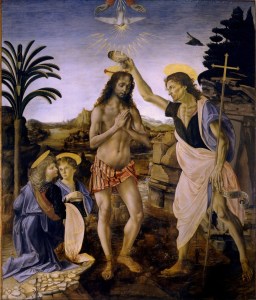
And the nature of the water itself is not the essential, but the act of submission to God’s requirement.
When Namaan comes from Aram seeking Elijah in hope of a cure for his leprosy, the prophet tells him via a messenger to bathe seven times in the Jordan. Namaan is outraged by Elijah’s behaviour:
‘I thought that he would surely come out to me and stand and call on the name of the Lord his God, wave his hand over the spot and cure me of my leprosy. Are not Abana and Pharpar, the rivers of Damascus, better than all the waters of Israel? Couldn’t I wash in them and be cleansed?’ (2 Kings 5:11-12).
But he relented, overcoming his pride, and was cured. There is much in this story, not least the unbelief of Israel to which Jesus makes reference (Luke 4:27) but it can also be seen that the water itself was not the agent of his cure, but Namaan’s faith and submission to God’s will.
Nor does it matter who officiates. Jesus, after all, asked John to baptize him, even though John considered himself unworthy,
But John tried to deter him, saying, ‘I need to be baptised by you, and do you come to me?’
Jesus replied, ‘Let it be so now; it is proper for us to do this to fulfil all righteousness.’ Then John consented. (Matthew 3:14-15)
And Jesus did not baptise but allowed his disciples to baptise for him (John 4:2). Paul reinforces that the identity of the officiate is immaterial, any believer can baptise, as commanded and proceeding from the authority of Jesus (Matthew 28:18).
I thank God that I did not baptise any of you except Crispus and Gaius, so no one can say that you were baptised in my name.(1 Corinthians 1:14-15)
Moreover this is a one-off act. There is one baptism for the forgiveness of sin, unlike the High Priest’s purification, this does not need repeating.
John the Baptist paves the way for Jesus…
‘I baptise you with water for repentance. But after me comes one who is more powerful than I, whose sandals I am not worthy to carry. He will baptise you with the Holy Spirit and fire. (Matthew 3:11)
…and Jesus leaves the his Spirit, for it is Holy Spirit the baptises the heart, in fact he renews it:
I will sprinkle clean water on you, and you will be clean; I will cleanse you from all your impurities and from all your idols. I will give you a new heart and put a new spirit in you; I will remove from you your heart of stone and give you a heart of flesh. And I will put my Spirit in you and move you to follow my decrees and be careful to keep my laws. (Ezekiel 36:25-27)
 God Breathed Words