ARMAGEDDON

For they are demonic spirits, performing signs, who go abroad to the kings of the whole world, to assemble them for battle on the great day of God the Almighty… and they assembled them at the place that in Hebrew is called Armageddon.  (Revelation 16:14&16)

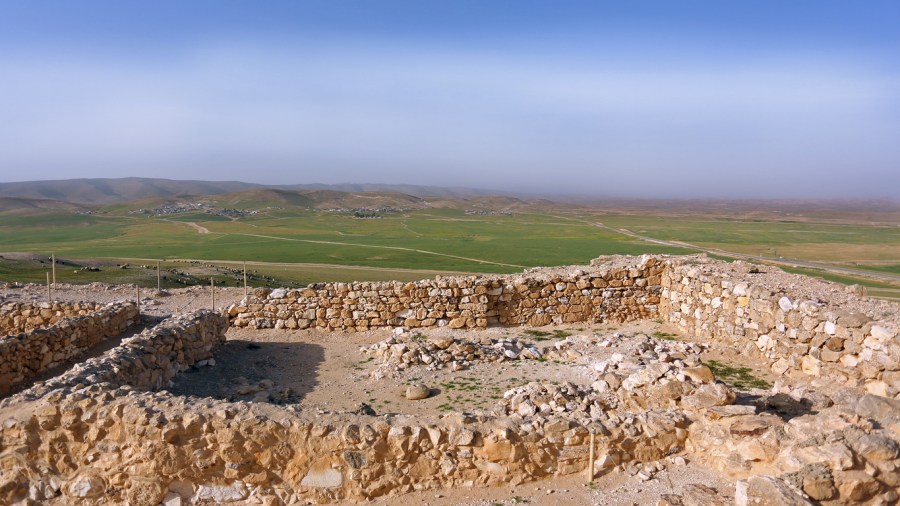
Armageddon has become the byword for complete and utter catastrophe; but in the Bible, it is location associated with several battles.  Transliterated from Hebrew to Greek, Ἁρμαγεδών, this is Harmagedon, from הַר har, ‘hill country’ and Megiddo, a city in the old tribal land of Manasseh overlooking the Jezreel Valley.  Today, the site is known as Tel Megiddo and is found 19 miles south-east of Haifa in the north of modern Israel.

Read more

CONVICTION

Now faith is the assurance of things hoped for, the conviction of things not seen.  (Hebrews 11:1)

A conviction is a firmly and strongly held belief and in the ESV Bible translation it stands for the Greek word ἔλεγχος elegchos, which can mean ‘test’ or ‘proof’, but here it means to believe fervently.

A court conviction is the decision based on solid and compelling evidence, and it is the verdict based on the balance of that evidence. 

Read more

ASSURANCE

Now faith is the assurance of things hoped for, the conviction of things not seen.  (Hebrews 11:1)

The Bible provides the most succinct definition of Christian faith and it comes in two parts.  This post will look at the first part and for that it is necessary to understand the word ‘assurance’ (for the second part, please see subsequent post, ‘conviction’).

Faith in Jesus is the condition he himself sets for deliverance from death.  Speaking before the tomb of Lazarus, Jesus says to his sister Martha:

‘I am the resurrection and the life.  Whoever believes in me, though he die, yet shall he live… (John 11:25)

Read more

SABBATH REST

there remains a Sabbath rest for the people of God, for whoever has entered God’s rest has also rested from his works as God did from his… (Hebrews 4:9)

The focus of New Testament book known as ‘Hebrews’ is apostasy; specifically of those Jews who had previously made a profession that Jesus was the Messiah.  Under Roman rule, Jews and their strict observance of the Law of Moses was more than tolerated, it was facilitated.  There was no greater example of this than special dispensation to have day of rest – the concept of having a day off each week being anathema to the commercially minded Roman.

‘Rest’ translates the noun κατάπαυσις katapausis, derived from the verb katapauó, the combination of the preposition kata ‘down from’ and pauó ‘to make to cease’ or ‘hinder’.  Classically, katapausis could mean a lull, or the state of being becalmed, but in New Testament Greek it stands for repose and was used to represent the ‘inactivity’ of the Sabbath.

Read more

THOUGHT(S)

Destroy arguments and every lofty opinion raised against the knowledge of God, and take every thought captive to obey Christ… 

(2 Corinthians 10:5) 

The word translated ‘thought’ is νόημα (noéma) derived from the verb noiéō which is from noús mind, so we get the product of the mind, thought, and the activity ‘thinking’; however, the suffix -ma is suggestive of the final product, and a fuller translation is therefore ‘purpose’ or ‘design’.  [Indeed, Oswald Chambers in his devotional reading for 9th September in ‘My Utmost for His Highest’ takes noéma to be ‘project’.]

Read more

MACEDONIA

And a vision appeared to Paul in the night: a man of Macedonia was standing there, urging him and saying, ‘come over to Macedonia and help us.’  (Acts 16:9)

On his return to Galatia, the apostle Paul had planned on expanding his mission to the Roman province of Asia; but receiving an unspecified negative sign sent by the Holy Spirit that barred him from travelling west, he decided to head north to Bithynia and Black Sea coast, only to be prevented again.  Then he was sent a positive sign in the form of a vision, so informing where he was to go.  However, there is good cause to speculate that this was a test for the apostle because, historically, the Macedonians had visited great harm on his people, the Jews and had left a legacy that challenged those who feared God and observed His Holy Law. 

Μακεδονία, Macedonia, was the northern Roman province to the north of Achaia, or Greece. Though to Paul and all Jews, Greeks were interchangeable, Macedonia was not Greece.

Read more

(The circumcision of) TIMOTHY

Paul wanted Timothy to accompany him, and he took him and circumcised him because of the Jews who were in those places, for they all knew that his father was a Greek.  (Acts 16:1-2)

Timothy’s Greek father gave his son a suitably Greek name, Τιμόθεος.  Timotheos ‘honoured by God’, derived from timé, ‘accorded honour’ or ‘perceived value’ and theos, a ‘god’.  It is not clear whether in naming his son, the god Timothy’s father had in mind was a god of the pagan pantheon or the God of Abraham; but it is likely to be the latter, because Paul tells us his mother was Jewish, which meant Timothy was Jewish (as by Hebrew tradition, racial attribution is from the mother not the father.)

Read more

WICKED

There is a vanity that takes place on earth, that there are righteous people to whom it happens according to the deeds of the wicked, and there are wicked people to whom it happens according to the deeds of the righteous. I said that this also is vanity.  (Ecclesiastes 8:14)

Kohelet, the unnamed author of Ecclesiastes, conducts a thought experiment.  If this was indeed Solomon, then he pours all his God-gifted wisdom into considering what mortal life is like without God.  One of his themes is the unfairness that the wicked gain and the righteous lose – and he is not wrong, but only if the death is the end and a just God does not exist.

The word that translated ‘wicked’ is the Hebrew adjective רָשְׁע rasha and it means ‘guilty’, ‘criminal’ or ‘evil’.

Read more

(Commit) SIN

Whoever commits sin also commits lawlessness, and sin is lawlessness.  

(1 John 3:4)

Modern English receives the word ‘sin’ from the Anglo Saxon synne, which has much in common with the Greek word John uses, ἁμαρτία hamartia, as both convey the sense of a misstep and came to mean a ‘violation of law’ – in the somewhat archaic usage, ‘trespass’ or ‘transgression’.  Sin is an act both of omission and commission, yet in both instances, for sin to be sin, it has to be ‘committed’; even failing do what should be done is a deliberate act; and a sin is no less committed even it is thoughtless, reckless or impetuous as opposed to that which is premeditated or calculated.  Jesus of course, extends this act to include intent, not simply the execution:

‘But I say to you that everyone who looks at a woman with lustful intent has already committed adultery with her in his heart…’ (Matthew 5:28)

Read more

(The Naming of) Cain and Abel

Now Adam knew Eve his wife, and she conceived and bore Cain, and said, ‘I have acquired a man from the Lord.’ Then she bore again, this time his brother Abel.  (Genesis 4:1-2a)

The first humans to ever be born were given names with meaning.  Eve explains why her first-born, Cain, is so named.  From the Hebrew verb קָנָה qanah means ‘to get or acquire’, Eve would draw attention and remind Cain that he was an act of God, from which she benefitted and by which he was ‘gotten’.  

Read more