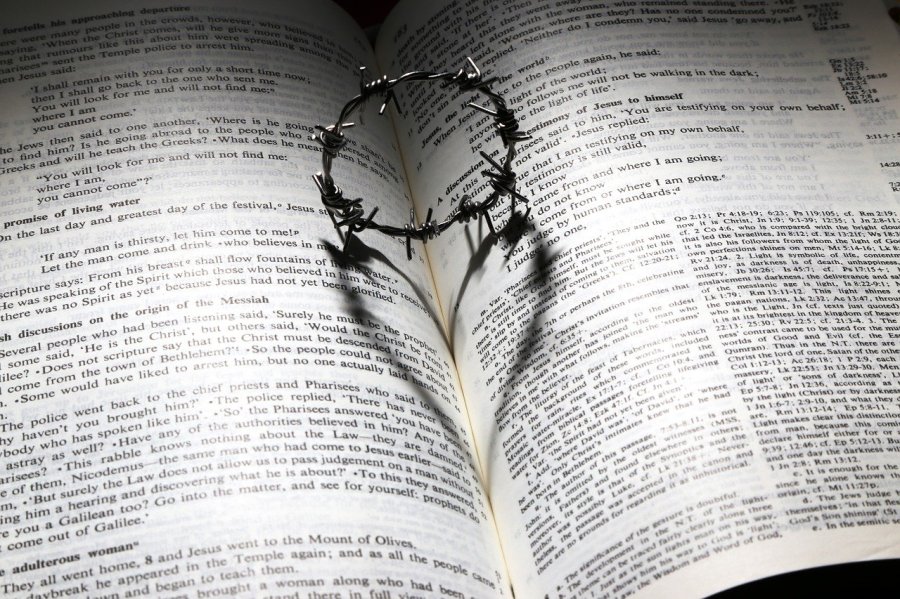
ANGER

‘In your anger do not sin’: do not let the sun go down while you are still angry,and do not give the devil a foothold.  (Ephesians 4:26-27 NIV)

Many deem anger to be a sin, so to what does Paul elude here?  Actually, he quotes from the Septuagint:

Answer me when I call, O God of my righteousness!
    You have given me relief when I was in distress.
    Be gracious to me and hear my prayer!
O men, how long shall my honour be turned into shame?
    How long will you love vain words and seek after lies? Selah
But know that the Lord has set apart the godly for himself;
    the Lord hears when I call to him.
Be angry, and do not sin;
    ponder in your own hearts on your beds, and be silent.
 (Psalm 4:1-4)

David is crying out to God but also pleading with his enemies (possibly rhetorically).  He is asking them to bear their anger and not act upon it.  And it is this that Paul reiterates to the man and woman now set apart in Christ to deal differently with anger, knowing full well that any opposition, prejudice or persecution will provoke anger.

Read more
SILENCE (Hush)

When the Lamb opened the seventh seal, there was silence in heaven for about half an hour.  (Revelation 8:1)

The scene is the throne room of God. Transported in a vision, John the Apostle witnesses the enactment of salvation, and he is moved to tears:

Then I saw in the right hand of him who was seated on the throne a scroll written within and on the back, sealed with seven seals.  And I saw a strong angel proclaiming with a loud voice, “Who is worthy to open the scroll and break its seals?” 

And no one in heaven or on earth or under the earth was able to open the scroll or to look into it, and I began to weep loudly because no one was found worthy to open the scroll or to look into it. 

And one of the elders said to me, “Weep no more; behold, the Lion of the tribe of Judah, the Root of David, has conquered, so that he can open the scroll and its seven seals.”  (ibid 5:1-5)

Read more

(The Promise of) VICTORY

To the one who is victorious, I will give the right to sit with me on my throne, just as I was victorious and sat down with my Father on his throne.  (Revelation 3:21)

In the Bible book that contains John’s apocalypse, Jesus reveals to his disciple an assessment of the seven churches; which, in the apocalyptic symbolism where the number seven represents completeness, is the assessment of the church in its totality.  It is a sobering read because the body of believers is clearly beset.  That it is persecuted should come as no surprise, but what is shocking (or should be) is the parlous internal conflict. 

Read more

(Second) Coming

For as the lightning comes from the east and shines as far as the west, so will be the coming of the Son of Man.  (Matthew 24:27)

Jesus is speaking to four of his disciples telling them of what to expect in the end times and specifically, the signs of his second coming. The Greek word that translates the participle of the verb ‘to come’ is actually a noun παρουσία parousia; while this word has a common meaning, as here in Paul:

…God, who comforts the downcast, comforted us by the coming (parousia) of Titus…(2 Corinthians 7:6)

Actually, Jesus is referring the Parousia, the event of his glorious and triumphal return, where none will doubt his complete splendour and power; therefore, Jesus invokes the second and specific meaning of this Greek word, where the arrival of a King during a royal progression through his realm would bring his regal presence.

Read more

LOVE

Whoever does not love does not know God, because God is love.  (1 John 4:8)

The noun ‘love’ translates: ἀγάπη; agapé; this word denotes love or goodwill that comes from moral preference.  It occurs 116 times is the New Testament in every book apart from the Gospel Mark and the James’ encyclical.

Love is then a disposition, God is disposed to love and chooses to act upon it:

For God so loved (apapeo) the world, that he gave his only Son, that whoever believes in him should not perish but have eternal life.  (John 3:16)

Read more