
OVERCOME

‘Take heart; I have overcome the world.’ (John 16:33b)

Following the Passover Meal, Jesus prepares his disciples telling them he is about to leave them, but he will send the Paraclete in his place.  

I have said these things to you, that in me you may have peace. In the world you will have tribulation… (ibid 16:33a)

He knows they will suffer the loss, not least, initially in their faith that the broken man on the cross was not the Messiah they hoped he was.  With the exception of John, performing the family duty of supporting his aunt, Mary, the disciples would scatter and return to Galilee.

But it easy to pass over his summary statement, that he has ‘overcome the world’, noting this is a completed action, in other words, he can surrender to death knowing he is sinless, and that is a victory. 

The Greek verb νικάω nikaó means to vanquish, conquer, prevail over and it derives from the Niké, the pagan goddess of victory.  So, Jesus saying that he has already won a victory even before passing test of obedience in Gethsemane, and rendering up his life and spirit to his Father.

Read more

INVITATION (to dine)

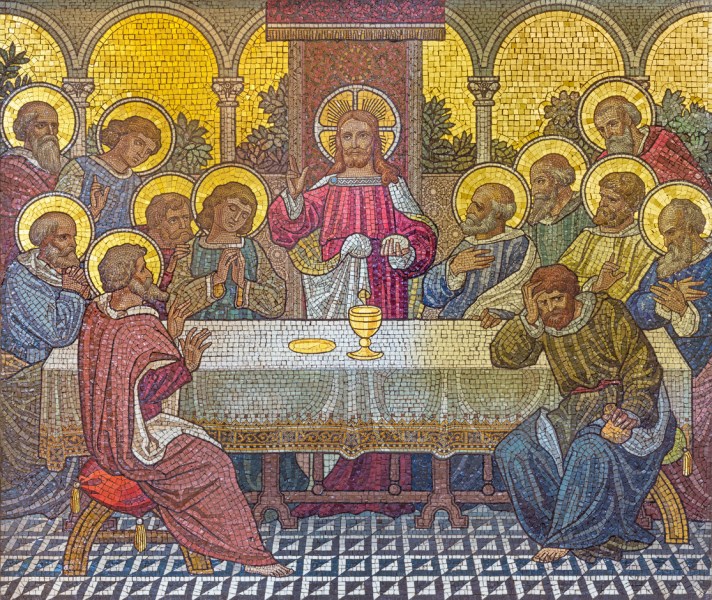
When one of the Pharisees invited Jesus to have dinner with him, he went to the Pharisee’s house and reclined at the table.  (Luke 7:36)

Gospel accounts of Jesus dining with others are manifold.  The Greek verb φάγω phago means simply eat, but he is asked, ἐρωτάω erótaó, and his presence requested – in other words, he is invited – on many occasions, and by many different kinds of people.  There are those of high society, which in Jesus’ day, were the ultra-religious.  In addition to the head quotation, Luke records two other instances of Jesus accepting an invitation to dine in a Pharisees’ home, 11:37 and 14:1 but, of course, the Pharisees were also critical that Jesus was indiscriminate in his choice of table.

Read more

SHAME

God chose what is foolish in the world to shame the wise; God chose what is weak in the world to shame the strong; God chose what is low and despised in the world, even things that are not, to bring to nothing things that are,so that no human being might boast in the presence of God.  (1 Corinthians 1:27-29)

Shaming is a process of belittlement and Paul tells us that how God uses it for his good purpose.  The Greek word here is καταισχύνω (kataishuno) meaning to disgrace, confound or dishonour.

But it is equally important to note why God would do such a thing, which stems from the desire to bring all to repentance and through faith to restore hope.

Read more

STEPHEN

They chose Stephen, a man full of faith and of the Holy Spirit… (Acts 6:5)

Stephen was among the founding members of the church in the immediate aftermath of Jesus’ ascension.  His name is Greek, Στέφανος (Stephanos) and it means ‘crown’.

Stephen was one of seven ‘deacons’ (from διακονέω diakoneó to serve ‘waiting tables’) chosen to oversee a dispute arising from perceived inequity in dispensing alms to the widows within the church.  We need to remember that at this early juncture the church bar a very few exceptions (such as the author of Acts) was Jewish, but Luke’s text shows that there were two types of Christian Jew, those who had kept the Law of Moses, and others who had adopted the ways of the prevailing culture and become ‘Greek’, these Luke refers to as Hellénistés, or Hellenists.

Read more

HATE (mortality)

 ‘Whoever loves his life loses it, and whoever hates his life in this world will keep it for eternal life.’  (John 12:25).  

The word ‘hate’ translates the verb μισέω miseó and it embraces both the unconditional: ‘detest’ and comparative: ‘love less than’.

Read more

DELIBERATE (SIN)

For if we go on sinning deliberately after receiving the knowledge of the truth, there no longer remains a sacrifice for sins, but a fearful expectation of judgement, and a fury of fire that will consume the adversaries.  (Hebrews 10:26-27)

Humanity is in an adversarial relationship with God, that is our natural state.  The writer of Hebrews says that once that realisation has dawned, in other words, been revealed by God, the soul is in a parlous position.  For thereafter continuing to behave as we have been has dire consequences which are eternally lethal.

Read more

DISCIPLE

… any one of you who does not renounce all that he has cannot be my disciple. (Luke 14:33)

The word translated ‘disciple’ is μαθητής mathétés and it means one who subjects themselves to mental effort or rigour; mathematics, clearly a subject that demands much intellectual application, derives from the same root, mathema, which is literally ‘that which is learnt’.

A disciple, then, is different to a ‘follower’.  During his ministry, large numbers of people followed Jesus from town to town and mountainside to lakeside, but only a handful transitioned into discipleship, why was this?  Because few were willing to make the necessary effort or to pay the extreme cost of worldly renunciation.  Jesus outlines by this first employing plain language:

Now great crowds accompanied him, and he turned and said to them, ‘If anyone comes to me and does not hate his own father and mother and wife and children and brothers and sisters, yes, and even his own life, he cannot be my disciple …’ (ibid 14:25-26)

Read more