ARMOUR (of God)

Put on the whole armour of God, that you may be able to stand against the schemes of the devil. (Ephesians 6:11)

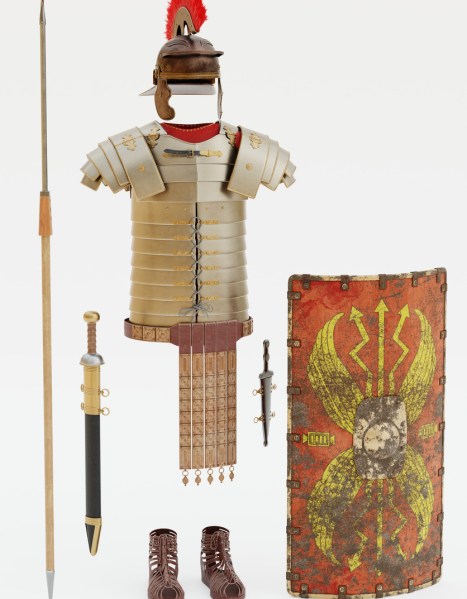
The ‘whole armour’ is the full set of equipment needed to wage warfare, and translates πανοπλία panoplia, whence English derives ‘panoply’.  Doubtless, he had in mind the Roman soldier fully furnished with helmet, breastplate, sandals and short sword.  To the Ephesians, Paul has already used the analogy of believers clothing themselves, ‘putting on’ (the verb ἐνδύω enduo, to be clothed or enveloped) the new self, the spiritual part downpayment of the new creation; but Paul would also have it known that this new spirit can come under attack.  

Read more

ARK

 Make yourself an ark of gopher wood.  Make rooms in the ark, and cover it inside and out with pitch. (Genesis 6:14)

Jesus says that 

The word translated ark is תֵּבָה tebah and it means a box or chest, which is why it came to English translations in this fashion; ‘ark’ derives from the Anglo Saxon ærc for casket – as clearly, God only tasks Noah to build a sea-worthy vessel, not a boat or ship.

Read more

MULTIPLY (WIVES)

Neither shall (a king) multiply wives for himself, lest his heart turn away (Deuteronomy 17:17)

The Hebrew word translated ‘multiply’ isרָבָה rabah and it is found in the first commandment given to humankind.

‘Be fruitful and multiply…’ (Genesis 1:28)

But in the head quotation, Moses is relaying instructions for the establishment of monarchy for the time when the Israelites will demand that they have a king as do other nations.

Read more

PERDITION

Those whom You gave Me I have kept; and none of them is lost except the son of perdition, that the Scripture might be fulfilled.  (John 17:12)

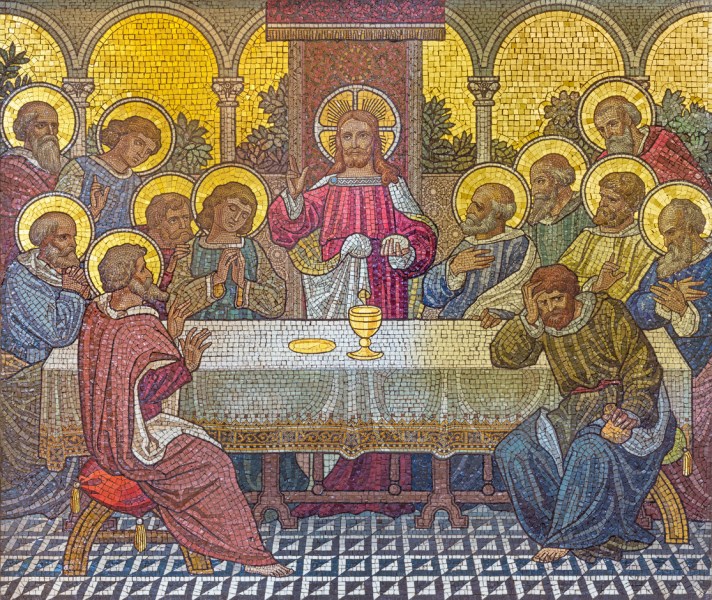
Jesus prays in respect of twelve men, those the heavenly Father gave into his care, and he reflects that he discharged his duty even to Judas, who he calls the ‘son of perdition’.  Judas he ‘lost’; and the translation is of the Koine Greek verb, ἀπόλλυμι apollumi, which is formed from the prefix apo, ‘away from’, and ollymi, ‘to destroy’, thus, ‘to utterly destroy after being cut away’.

Judas hanged himself and, in circumstances that are tantamount to the bathetic, ‘falling headlong, he burst open in the middle and all his entrails gushed out’, Acts 1:18.

Read more

(Christ’s eternal) ANGUISH

Out of the anguish of his soul he shall see and be satisfied; by his knowledge shall the righteous one, my servant, make many to be accounted righteous, and he shall bear their iniquities. (Isaiah 53:11) *

Jesus’ agony on the cross was for all to see, the spectacle of suffering was the deterrent the Romans intended; but Isaiah says Jesus endures spiritual torment.  Can it be that Jesus suffers even as he is glorified?  

The word translated ‘anguish’ is עָמָל amal which means trouble, labour or misery.  It intimates a sustained burden from which there is no escape.

Read more

SINNER

 ‘I have not come to call the righteous but sinners to repentance.’  (Luke 5:32)

Challenged as to why Jesus associates with sinners, Jesus’ reply no doubt stunned the Pharisees who studiously upheld the Law of Moses and thought themselves ‘righteous’, that is, in a place of right standing with God.

The word that translates ‘sinners’ is the Greek adjective (substantival – acting as a noun) ἁμαρτωλός hamartólos, literally ‘falling well-wide of the target’, but here stands for the most blatant and inveterate of transgressors.

Who is Jesus speaking about?  Every single human being that ever lived apart from himself.

Read more

COMMAND

‘All authority in heaven and on earth has been given to me. Therefore, go and make disciples of all nations, baptising them in the name of the Father and of the Son and of the Holy Spirit, and teaching them to obey everything I have commanded you. And surely, I am with you always, to the very end of the age.’ (Matthew 28:18-20)

This known as the Great Commission, is Jesus’ final instructions before he ascends heavenwards.  Here ‘command’ translates the Greek verb, ἐντέλλομαι entellomai, to charge or enjoin, to issue injunctions or instructions.  The aorist tense, conveying a single and discreet action, is in the first-person singular, ἐνετειλάμην eneteilamen.

In the companion post to ‘Obedience’, it is seen that Jesus expects discipleship to be based on obedience to his commands.  On other words, obeying to his commandments is the foundation of the relationship.  It is non-negotiable.

Read more

Obedience

‘Does the Lord delight in burnt offerings and sacrifices
    as much as in obeying the Lord?
To obey is better than sacrifice,
    and to heed is better than the fat of rams.
For rebellion is like the sin of divination,
    and arrogance like the evil of idolatry.
Because you have rejected the word of the Lord,
    he has rejected you as king.’
 (1 Samuel 15:22-23)

The Hebrew word that is translated ‘to obey’ is שָׁמַע ‘to hear’.  When God speaks, all must not simply hear, but listen and take heed.   The same imperative proceeds what Jesus defines as the Greatest Commandment:

Hear, O Israel: The Lord our God, the Lord is one.You shall love the Lord your God with all your heart and with all your soul and with all your might.  (Deuteronomy 6:4)

Read more

Gaza

Samson did not know that the Lord had departed from him.  Then the Philistines took him and put out his eyes, and brought him down to Gaza.  (Judges 16:20c-21)

Biblically, Gaza is probably best associated with Samson, whom God turned over to his enemies as a result of his inveterate disobedience.

Gaza, עַזָּה or Ghazza, was one of the five city states of Philistia, the ancient kingdom of the Philistines.  And were a thorn in the side of Israel, as seen by God’s reprove of Joshua:

Read more

TAKEN

‘Two men will be in the field; one will be taken and one left.Two women will be grinding at the mill; one will be taken and one left.’  (Matthew 24:40-41)

Jesus is speaking to his closest disciples and the context is his return, ‘the coming of the Son of Man’; however, what Jesus is describing, where some are ‘taken’ while others are not, is usually referred to as ‘the Rapture’.  The word ‘rapture’ comes to English from the medieval Latin raptura which means to seize forcibly, (it is also the derivation of ‘rape’).  

The Greek verb Matthew employs is παραλαμβάνω paralambanó and although the verb lambanó is an active verb that conveys the sense of aggression, it is modified by the prefix para ‘close or alongside’.  That people are ‘taken’ may be forcible and one without consultation, but does this suggest that this is something to be feared?

Read more