WORSHIPPING (GOD)

‘O King of the nations!

    Who will not fear, O Lord,
    and glorify your name?
For you alone are holy.
    All nations will come
    and worship you,
for your righteous acts have been revealed.’ 

(Revelation 15:4)

This is the heavenly song of the faithful ‘overcomers.’  They declare the Biblical truth that everyone will worship God in the eternal, even those that rejected and denied His existence.  So, are all the worshippers of one mind?  Are all willing?

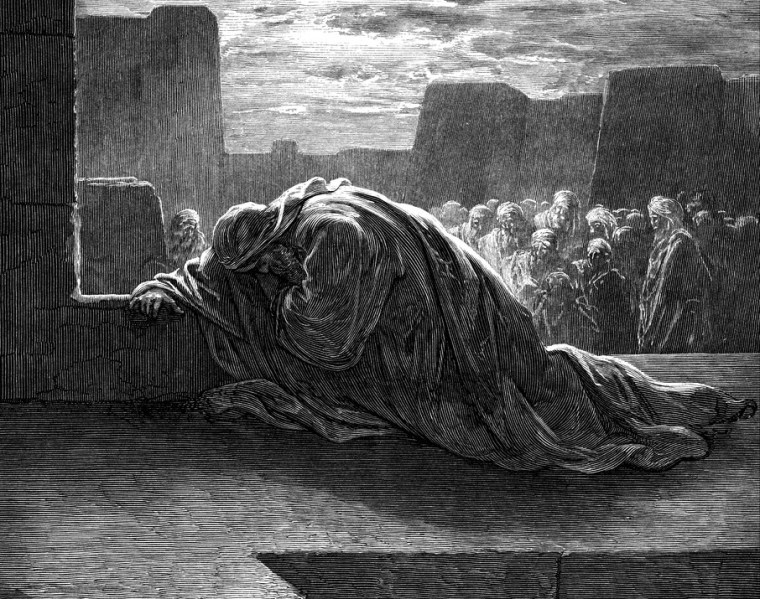
The word translated here as ‘worship’ is the Greek verb προσκυνέω proskuneó from pros ‘towards’ and kyneo ‘kiss’.  This describes obeisance, the action of kneeling before or even lying at the feet of another to kiss the ground, not daring to kiss the object of supreme reverence.  

Read more

(God’s perfect) JUSTICE

For the Lord is a God of justice;
    blessed are all those who wait for him.
  (Isaiah 30:18b)

The Hebrew word translated ‘justice’ is מִשְׁפָט mishpat, and covers a range of meaning, that includes all things related to judgment, regulation and condemnation.  It upholds that justice is served when transgression is punished.  

Made in God’s image, humankind seeks perfect justice and finds the world lacking it.  Scripture affirms this, asserting that, seen through a temporal lens, justice can only be found at two events, the cross and the final judgment.  Thus, it is important to wait for justice to be done.

Read more

ANCHOR

We have this as a sure and steadfast anchor of the soul, a hope that enters into the inner place behind the curtain, where Jesus has gone as a forerunner on our behalf, having become a high priest for ever after the order of Melchizedek.  (Hebrews 6:19-20)

Anchor is the transliteration of the Latin ancora, itself from the Greek ἄγκυρα agkura.  While the word is familiar enough, the usage in Hebrews is less obvious.

Read more

WEAKNESS

In order to keep me from becoming conceited, I was given a thorn in my flesh, a messenger of Satan, to torment me. Three times I pleaded with the Lord to take it away from me. But he said to me, ‘My grace is sufficient for you, for my power is made perfect in weakness.’  

(2 Corinthians 12:7-9) 

What Jesus tells Paul appears contradictory, and indeed it is baffling.  Yet scripture is not given by God to obscure, rather it is revelatory.

How can ‘any power be made perfect in weakness?’  This is not in self-handbooks, let alone the leadership playbook beloved of chief executives, politicians; those with presidential aspiration or any the would-be despots seek power and hold through strength and domination.

Read more

FRUIT

‘As the branch cannot bear fruit by itself, unless it abides in the vine, neither can you, unless you abide in me. I am the vine; you are the branches.’  

(John 15:4-5a)

Jesus uses the final hours before his arrest leading to the sham trial and crucifixion, to prepare his disciples for their task.  It will fall to them to cultivate the Gospel, so it may be fruitful.  The word translated ‘fruit’ is καρπὸς karpos is the produce of the mature plant and the means by which it is propagated.

Read more

POINTLESS

Pointless! Pointless! says Kohelet. Utterly meaningless! Nothing matters!  

(Ecclesiastes 1:2; Complete Jewish Bible)

Ecclesiastes stands with Job as wisdom literature within the sacred Hebrew Scripture which aims is to examine the human condition; however, they differ in that while Job remains committed to his faith in God, the author of Ecclesiastes ‘Kohelet’ is almost atheistic in his scepticism, beginning with the famous nihilistic declaration that all is pointless.

‘Pointless’ translates הֶבֶל hebel, which is ‘vapour’, literally the breath that condenses in cold air; figuratively it stands for something ephemeral, insubstantial and meaningless.  

Read more

SUFFICIENCY

And God is able to make all grace abound to you, so that having all sufficiency in all things at all times, you may abound in every good work.  (2 Corinthians 9:8)

Paul is exhorting the faithful Achaians to respond as the Macedonians and give generously to brethren in Jerusalem.   He illustrates this by quoting from the psalter:

He has distributed freely, he has given to the poor;
    his righteousness endures for ever.
  (Psalms 112:9)

Thus, the apostle asserts the concept of God’s sufficiency is an essential Biblical truth, not just for the doubting Corinthian.

Read more

LUKEWARM

‘I know your works: you are neither cold nor hot. Would that you were either cold or hot! So, because you are lukewarm, and neither hot nor cold, I will spit you out of my mouth.’  (Revelation 3:15-16)

The revelation given to John mostly concerns the Last Days, in Greek ἔσχᾰτος eschatos, but not only does that cover the end of history and the world, it also includes present age.  To this end, it begins with Jesus’ assessment of the state of his Church.  While his audit names the major centres of the burgeoning faith in Asia Minor (Anatolian Peninsula), some suggest that each church also represents the complete Church over time; thus the last, Laodicea, conveys the state of today’s Church.  Be that as it may, Jesus’ rebuke of tepidity is stark and not a little startling.  

Read more

DEPOSIT

When you believed, you were marked in him with a seal, the promised Holy Spirit, who is a deposit guaranteeing our inheritance until the redemption of those who are God’s possession.  (Ephesians 1:14)

To those ‘sealed’ as God’s possession, based on gospel faith, there is a deposit that acts as a guarantee of inheritance within His kingdom.  The word ‘deposit’ translates the Greek noun ἀρραβών (arrabón) meaning a down payment or surety; the first instalment of a payment to be redeemed in full at a later date.

Read more

SEALED

In Christ you also, when you heard the word of truth, the gospel of your salvation, and believed in him, were sealed with the promised Holy Spirit. (Ephesians 1:13)

The word translated ‘sealed’ is the Greek verb σφραγίζω sphragizó describing the act of fixing a seal or stamp to something attesting to ownership.  This conveys the full authority, backing and security of the owner and at one time might also involve the use of tattoos; hence the derivation of this prophetic commandment to the world that John witnessed in his revelation:

Read more