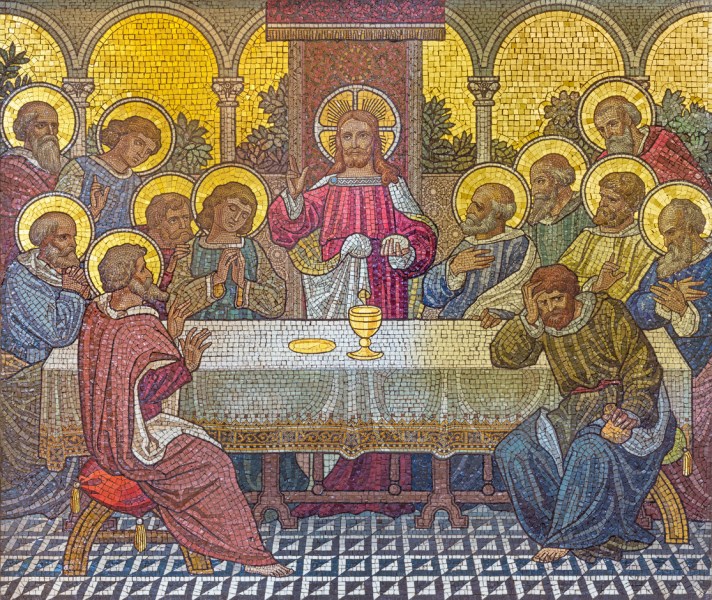
INVITATION (to dine)

When one of the Pharisees invited Jesus to have dinner with him, he went to the Pharisee’s house and reclined at the table.  (Luke 7:36)

Gospel accounts of Jesus dining with others are manifold.  The Greek verb φάγω phago means simply eat, but he is asked, ἐρωτάω erótaó, and his presence requested – in other words, he is invited – on many occasions, and by many different kinds of people.  There are those of high society, which in Jesus’ day, were the ultra-religious.  In addition to the head quotation, Luke records two other instances of Jesus accepting an invitation to dine in a Pharisees’ home, 11:37 and 14:1 but, of course, the Pharisees were also critical that Jesus was indiscriminate in his choice of table.

Read more

FASTING

While they were worshipping the Lord and fasting, the Holy Spirit said, ‘Set apart for me Barnabas and Saul for the work to which I have called them.’  So after they had fasted and prayed, they placed their hands on them and sent them off. (Acts 13:2-3)

In Greek, the verb ‘to fast’ is νηστεύω nesteuo from ne,implying negation, and ἐσθίω esthio ‘to eat’, thus nesteuo is literally ‘to not eat’.  But in the context of the Bible, this is abstinence not starvation.  Thus, a Biblical definition of a fast is to refuse food in order to better focus on God – or put in the negative, and especially in a modern context, fasting without prayer is merely dieting.

Read more

Lord – hláford

breaking-bread

 …the Son of Man is Lord even of the Sabbath.’ (Mark 2:28)

The Greek word κύριος kyrios (Strongs 2962) -and its various declensions -appears 722 times in the New Testament, most often in reference to Jesus; it means lord or master, or properly ‘a person possessing absolute rights of ownership’. Read more