ARMOUR (of God)

Put on the whole armour of God, that you may be able to stand against the schemes of the devil. (Ephesians 6:11)

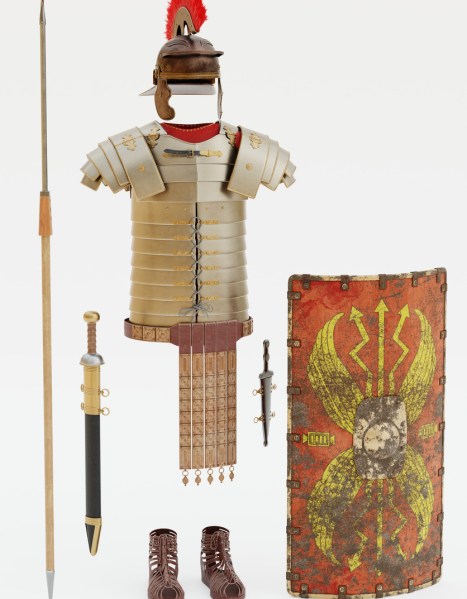
The ‘whole armour’ is the full set of equipment needed to wage warfare, and translates πανοπλία panoplia, whence English derives ‘panoply’.  Doubtless, he had in mind the Roman soldier fully furnished with helmet, breastplate, sandals and short sword.  To the Ephesians, Paul has already used the analogy of believers clothing themselves, ‘putting on’ (the verb ἐνδύω enduo, to be clothed or enveloped) the new self, the spiritual part downpayment of the new creation; but Paul would also have it known that this new spirit can come under attack.  

Read more

RESPECT

Always be prepared to give an answer to everyone who asks you to give the reason for the hope that you have. But do this with gentleness and respect, keeping a clear conscience, so that those who speak maliciously against your good behaviour in Christ may be ashamed of their slander. For it is better, if it is God’s will, to suffer for doing good than for doing evil.  (1 Peter 3:15-17)

If evangelism has become tainted with the association with ranting and bigotry then perhaps it is because not enough Christians took to heart what Peter says in his first letter.  What should characterise the messenger who brings the good news of Jesus, who gave of himself to redeem humankind, is contained in the two words translated as gentleness and respect; the evangelist should speak gently and respectfully.

Read more

WILFUL

For we, wilfully sinning after the receiving the full knowledge of the truth, no more for sins does there remain a sacrifice  but a certain fearful looking for of judgment, and fiery zeal, about to devour the opposers…(Hebrews 10:26)

This notoriously difficult and controversial passage reads this way in the NIV.

Read more

Doubt (of the faithful)

Then the eleven disciples went to Galilee, to the mountain where Jesus had told them to go. When they saw him, they worshipped him; but some doubted. (Matthew 28:16-17)

 Now the Greek word in this passage that is translated as doubt is the verb διστάζω distazo, which means literally two-fold or double stance. To be caught between two positions, to vacillate.

Read more

GOODNESS (of God)

‘Why do you ask me about what is good?’ Jesus replied. ‘There is only One who is good…’ Matthew 19:17

Jesus is approached by a man; the text identifies him as possessing youth and wealth, a heady combination, yet his question to Jesus is directed toward his salvation.

‘Teacher, what good thing must I do to get eternal life?’ (ibid 19:16)

Read more

FAITH – Does God choose us or we Him?

Now faith is confidence in what we hope for and assurance about what we do not see.  This is what the ancients were commended for. (Hebrews 11:1-2)

Thus, begins chapter eleven in the book of Hebrews. The chapter’s burden is to cite those ancients for their faith, thereby making the point of the criticality of faith as the fundament to any human being’s relation to God.  And this to the apostate Jews who were slipping away from faith in Christ as the persecution of the early church quickened.

Read more

PRIDE


Can any Christian take pride in their actions.  Paul suggests you can.  In this blog post, I examine what the Bible tells us about pride and its flip side, humility and how both qualities reveal on what, and in whom, men and women find their security.

Each one should test their own actions. Then they can take pride in themselves alone, without comparing themselves to someone else… (Galatians 6:4)

Greek word translated is καύχημα; kauchéma (Strong’s 2745) and means ‘boast’; properly, it is the grounds for boasting; in other words pride, self-glorification or exultation.

Pride is almost always a negative quality in Scripture but in his letter to the churches of Galatia, Paul, within a narrow definition, says a person can take some credit for their actions.  This is an important point, because the follower of Christ is not a puppet, God continues to grant license to make poor decisions along with wise ones, and do evil along with good.

Read more

DOUBT (of John the Baptist)

If faith is commitment before knowledge, then doubt is inevitable.  The most famous of doubters is Thomas the twin, one of Jesus’s disciples, but John the Baptist also came to doubt Jesus as the Christ.  How given his own anointing could he doubt?  In this post, I examine, doubt, where it arises and how it is part of faith.

Read more