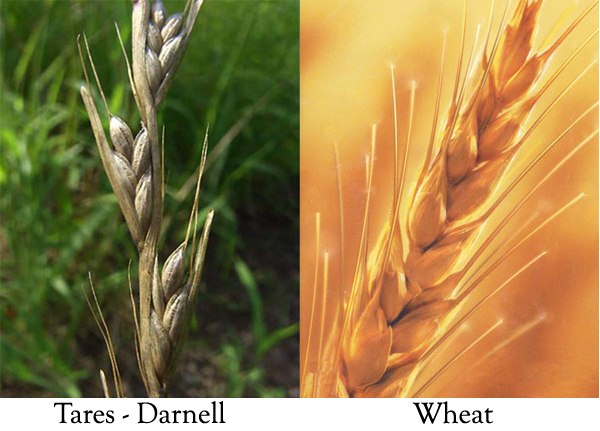
So the servants of the householder came and said unto him, Sir, didst not thou sow good seed in thy field? from whence then hath it tares?
He said unto them, An enemy hath done this. The servants said unto him, Wilt thou then that we go and gather them up?
But he said, Nay; lest while ye gather up the tares, ye root up also the wheat with them.
Let both grow together until the harvest: and in the time of harvest I will say to the reapers, Gather ye together first the tares, and bind them in bundles to burn them: but gather the wheat into my barn. (Matthew 13:27-30 KJV)
Tares are weeds, most commonly vetches, but there is an older meaning that cognates to the Proto Germanic tarwo, from where the Dutch derive their name for wheat ‘tarwe’.
The Greek is ζιζάνιον zizanion (Strong’s 2215) that was ‘spurious or bastard wheat.’
Jesus is speaking very specifically of a weed called ‘darnel’ (Lolium temulentum). It is a poisonous plant that is so alike wheat, it is called ‘false wheat’. If mistakenly eaten, the darnel grain produces symptoms similar to drunkenness and nausea (temulentus is Latin for ‘drunk’) and while extremely unpleasant, the effects can also be fatal. Both seed and the juvenile plant are almost indistinguishable for wheat, only at senescence (full maturity) is the difference noticeable. At this stage, the roots will have become so entangled that pulling out the weed would bring the good wheat with it.
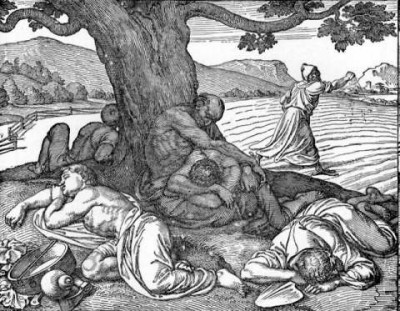
It is likely that Jesus was speaking historically about occasions when enemies creep into newly sown fields at night to broadcast darnel and thereby ruin the crop. But also, folk lore may have kept record of neighbours doing this to settle scores.
In this parable, Jesus is looking forward to his church. Amongst the body of true believers, the enemy, Satan, will ‘sow’ those who will work against him; moreover, the infiltrators will not be discernible and differentiated until the final harvest:
‘Not everyone who says to me, “Lord, Lord,” will enter the kingdom of heaven, but only the one who does the will of my Father who is in heaven. Many will say to me on that day, “Lord, Lord, did we not prophesy in your name and in your name drive out demons and in your name perform many miracles?”
Then I will tell them plainly, “I never knew you. Away from me, you evildoers!” (Matthew 7:21-23)
This teaches the sobering lesson that many in the church will not recognise themselves to be seeking to sabotage against the Kingdom purpose; they are deceived – and Jesus warns that many will be taken in by false teachers:
Watch out that no one deceives you. For many will come in my name, claiming, “I am the Messiah,” and will deceive many. (Matthew 24:4-5)
Paul had the same concern for the church of Corinth:
But I am afraid that just as Eve was deceived by the snake’s cunning, your minds may somehow be led astray from your sincere and pure devotion to Christ. For if someone comes to you and preaches a Jesus other than the Jesus we preached, or if you receive a different spirit from the Spirit you received, or a different gospel from the one you accepted, you put up with it easily enough….for such people are false apostles, deceitful workers, masquerading as apostles of Christ. And no wonder, for Satan himself masquerades as an angel of light. It is not surprising, then, if his servants also masquerade as servants of righteousness. (2 Corinthians 11:3-4 and 13-15)
How then does the follower of Christ test false prophets? Jesus says ‘by their fruit you will know them’ (Matthew 7:20). So, the follower is to look to their words and compare with Jesus’ – and that ‘word’ is his commandments…
Very truly I tell you, whoever obeys my word will never see death. (John 8:51)

Jesus’ parable of the wheat and the tares looks forward to the final judgement, when the analogy of the fire is also terrifying reality – lest any mistake symbolism for euphemism:
The angels will come and separate the wicked from the righteous and throw them into the blazing furnace, where there will be weeping and gnashing of teeth. (Matthew 13:49-50)
Therefore, the only assurance any follower of Christ can hold of being wheat over tare is through keeping Jesus’ commandments.
 God Breathed Words