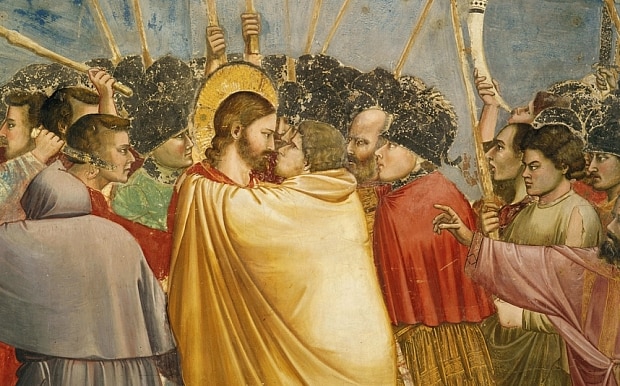
When Judas, who had betrayed him, saw that Jesus was condemned, he was seized with remorse and returned the thirty pieces of silver to the chief priests and the elders.
‘I have sinned,’ he said, ‘for I have betrayed innocent blood.’
‘What is that to us?’ they replied. ‘That’s your responsibility.’
So, Judas threw the money into the temple and left. Then he went away and hanged himself. (Matthew 27:3-5)
The Greek word translated as ‘remorse’ is μεταμέλομαι metamelomai (Strong’s 3338). The prefix meta, ‘after’ and melo ‘care’ or ‘concern over’ gives ‘to experience a change of concern after a change of emotion’, which is close in meaning to the English nouns ‘regret’ or ‘remorse’.
Why exactly Judas had a change of heart, it is not clear. It seems impossible to think that he believed that Jesus would not come to harm through his betrayal – although he might not have imagined his teacher would be condemned to death. The only indication Scriptures provides as to his motivation, was that Judas was overtaken by greed. Earlier in the chapter, Matthew writes this:
Then one of the Twelve – the one called Judas Iscariot – went to the chief priests and asked, ‘What are you willing to give me if I deliver him over to you?’ So, they counted out for him thirty pieces of silver. From then on Judas watched for an opportunity to hand him over. (verses 14-16)
It makes for sorry reading. At the Last Supper, Jesus identifies Judas as his betrayer, saying:
…woe to that man who betrays the Son of Man! It would be better for him if he had not been born. (verse 24)
This has been taken to mean that Judas condemns himself and that he puts himself beyond redemption, but is that so? Was God’s forgiveness denied him? After all, at no point does Jesus show him anything but pity. Even at the point of his betrayal, Jesus calls him ‘friend’ (verse 50).
All that is known about Judas’ state is that he is remorseful but regret is not enough for God, otherwise why would Jesus prophesy that it would be better he had never been born? To regret one’s actions and to feel shame is common to all, but stemming from regret, there are two other steps need to be taken (both open to Judas).

First, Jesus speaks of repentance:
‘If your brother or sister sins against you, rebuke them; and if they repent, forgive them. (Luke 17:3)
The word translated as repent is μετανοέω metanoeo (Strong’s 3340) and means a change of mind.
So, if remorse or regret is a change of heart, then repent is a change to one’s mind, and clearly Jesus make forgiveness conditional upon this revision in thinking resulting, moreover, in aligning those thoughts to God, so to do his will in future.
Paul elaborates:
Do not conform to the pattern of this world, but be transformed by the renewing of your mind. Then you will be able to test and approve what God’s will is – his good, pleasing and perfect will. (Romans 12:2)
This means then that when feelings of guilt and shame overwhelm, along with regret for the sin, there must be a determination to do something to make sure this does not happen again. To seriously consider and resolve to change habits and a real and genuine effort to convert those emotions into an impetus for radical self-revision.
Of course, Jesus recognises that this is not easy, adding:
Even if they sin against you seven times in a day and seven times come back to you saying “I repent,” you must forgive them.’ (ibid 17:4)
But there is there is still one more step that must be taken before God can welcome back the sinner – asking for His forgiveness and, in so doing, availing oneself of the freedom from eternal punishment that Jesus freely takes upon himself.
In the tragic conclusion to his sorry life, Judas hangs himself before Jesus is crucified and so is denies himself the witness to the greatest moment in the history of humankind. If Judas had asked for forgiveness even in prayer, there is nothing to suggest that forgiveness of the very act that instigated Jesus’ death upon the cross would have been withheld from him.
Scripture provides the stark contrast with Peter whose denial was also a form of betrayal. Peter wept bitter tears such was his regret, but he still loved Jesus as his Lord and Saviour. He was the first disciple to announce this, and while his courage failed him and he denied Jesus the man, he still held true to his master’s divinity; whereas there is nothing to suggest in the Gospels or Acts that Judas came to the same conclusion.
Judas’ memorial is this, often put in parenthesis as if Luke is making an incidental comment:
(With the payment, he received for his wickedness, Judas bought a field; there he fell headlong, his body burst open and all his intestines spilled out. Everyone in Jerusalem heard about this, so they called that field in their language Akeldama, that is, Field of Blood.) Acts 1:18-19
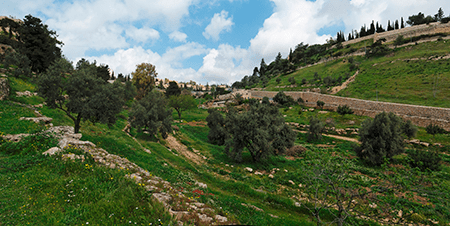
Could there have been an entirely redemptive outcome to Judas’ life? When Peter speaks over the crowd at Pentecost, he makes it clear that they nailed Jesus to the cross:
Therefore, let all Israel be assured of this: God has made this Jesus, whom you crucified, both Lord and Messiah.’
When the people heard this, they were cut to the heart and said to Peter and the other apostles, ‘Brothers, what shall we do?’
Peter replied, ‘Repent and be baptised, every one of you, in the name of Jesus Christ for the forgiveness of your sins. (Acts 2:36-38)
Is it not the case then, that every sinner, not just Judas, the Sanhedrin, Pilate or even the Jews who shouted for Barabbas before the procurator, shares in the bloodguilt? Is it not before every single person to feel remorse, repent and ask forgiveness of God the Father, who chose to subject his Son to death and dereliction for the sake of all creation? And if that is the case, then what would have prohibited Judas falling upon God’s grace and mercy in place of his desperate act of suicide, undertaken to stem the overpowering feelings of remorse.
 God Breathed Words