
While warrior cultures like that of the Vikings sought a heroic death, today death is feared or ignored. Western medicine is given over to the pursuit of protracting life, even at the expense of its quality. For humankind, however, death was not and is not God’s intention but is the result of men and women’s rebellion.
For the wages of sin is death… (Romans 6:23)
Greek word that translates death is θάνατος thanatos (Strong’s 2288), which can refer to physical or spiritual death, but here Paul is referring to the second death, when those not in Christ are condemned to Hell.
Scripture declares there are two deaths. The apostle John writes of his vision of the last judgement:
Then I saw a great white throne and him who was seated on it. The earth and the heavens fled from his presence, and there was no place for them. And I saw the dead, great and small, standing before the throne, and books were opened. Another book was opened, which is the book of life. The dead were judged according to what they had done as recorded in the books. The sea gave up the dead that were in it, and death and Hades gave up the dead that were in them, and each person was judged according to what they had done. Then death and Hades were thrown into the lake of fire. The lake of fire is the second death. Anyone whose name was not found written in the book of life was thrown into the lake of fire. (Revelation 20:11-15)
In this scene as described, everyone has died, and yet death is thrown into the lake of fire, or Hell – this means mortality is thus done away along with those that are not saved from hell. It is the second death that is the punishment not the first, this the wages of sin.
In fact, a careful examination of Scripture declares mortality a blessing and an integral part of God’s merciful plan of redemption.
To grasp this, it is important to understand God’s response to the original sin:
And the Lord God commanded the man, ‘You are free to eat from any tree in the garden; but you must not eat from the tree of the knowledge of good and evil, for when you eat from it you will certainly die.’ (Genesis 2:16)
Adam ate from the fruit and disobeyed God, invoking the consequence of death.
Death, then, is born of sin but so also was a new form of life, mortality. It will be a life without direct access to God himself and is the righteous curse along with toil, painful childbirth, disharmony between men and women, enmity between beasts – but there was hope, a way for the blighted creation to be redeemed.
For the creation was subjected to frustration, not by its own choice, but by the will of the one who subjected it, in hope that the creation itself will be liberated from its bondage to decay and brought into the freedom and glory of the children of God. (Romans 8:21-22)
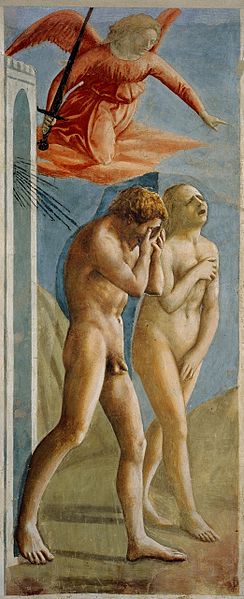
Crucially when Adam sinned, he was expelled from God’s presence but not to Hell, rather to a temporal existence. Mortality is therefore time granted to mankind by which Adam’s seed can reconcile themselves to God and by means of the Cross and Resurrection of Christ be made righteous to stand as Adam once did in God’s presence. And it is at the point when Adam and Eve were expelled from the Garden of Eden that God’s this merciful hope is revealed.
And the Lord God said, ‘The man has now become like one of us, knowing good and evil. He must not be allowed to reach out his hand and take also from the tree of life and eat, and live forever.’ (Genesis 3:22-23)
For if Adam had lived forever, it would have been to an existence without any possibility of redemption. He was banished from the garden and God’s divine presence but not straight to hell. And, it should be noted, that this gift is unique to mankind. God did not extend such grace to the fallen angels:
God did not spare angels when they sinned, but sent them to hell, putting them in chains of darkness to be held for judgment. (2 Peter 2:4)
Looking now from the perspective given mankind by the cross, mortality is a gracious stay of execution, in order that each man and woman has freedom to distance himself from Adam’s bitter inheritance. Each can do so by acknowledging Christ and thereby enter the intimacy of communion with God. Or, they are free to reject Christ and his mercy. But if any accept the gift of life, they can avoid the second death. All should view mortal death with gratitude.
Of course, this flies against the secular view.

To any that have no faith, death necessarily marks the end of life and the commencement of non-existence. When asked about this, many reply that they are happy with this, but this is a failure of imagination. None can conceive of oblivion simply because this is not the reality. Humankind are eternal beings – for God:
…has (also) set eternity in the human heart (Ecclesiastes 3:11)
And it is only now, in the post-enlightenment period that any such notion rejecting an after-life could gain traction. For the Jews, there was Sheol, which the Greeks called Hades, the afterlife of the spirit that will be done away with at the Last Judgement; for the tribes of Briton, there was the land of youth, Tír na n’Óg; and for the Saxon and Viking the promise of feasting in the mead-halls of their forefathers, and so on, in every recorded culture.
But if rejection of the hereafter seems to be a modern phenomenon, it is all the more important to realise that the death that Scripture focusses upon is the complete schism from God. Unfortunately, too many fix on this life as the be all and end all.
It is entirely consistent that those would reject God would also reject the notion of immortality. Viewed thus mortality as a curse to be undone and overcome. For this reason, mortal existence is not meant to be desirable. God never intended his precious creation (in whom he was well-pleased) to suffer this attenuated life. Job (14:1) says:
Mortals, born of woman, are of few days and full of trouble.
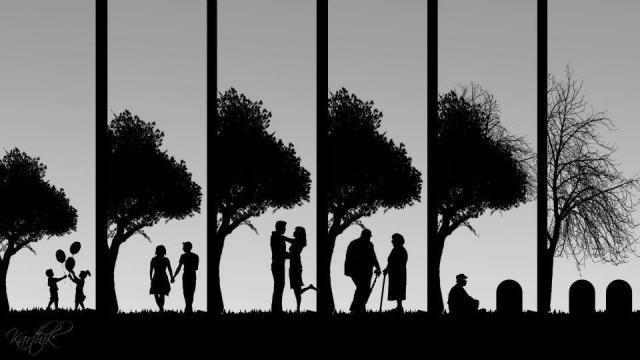
The life God intends for mankind is eternal and trouble free. Contrast Job’s pithy description with the vision given to John of our immortal existence in a restored Earth:
‘Look! God’s dwelling-place is now among the people, and he will dwell with them. They will be his people, and God himself will be with them and be their God. “He will wipe every tear from their eyes. There will be no more death” or mourning or crying or pain, for the old order of things has passed away.’ (Revelation 21:3-4)
Once more mankind has access to the Tree of Life, signalling immortality and that the curse of Eden (death) is revoked.
Then the angel showed me the river of the water of life, as clear as crystal, flowing from the throne of God and of the Lamb down the middle of the great street of the city. On each side of the river stood the tree of life, bearing twelve crops of fruit, yielding its fruit every month. And the leaves of the tree are for the healing of the nations. No longer will there be any curse. (Revelation 22:1-3)
Mortal death is meant to energise and engage the soul, as is the temporal suffering encountered. That a person has a mortal existence is God’s will; moreover, the manner and timing are the perfect expression of his purpose – it can be no other way, for He is sovereign. God brings mortal death when he chooses. It can be in response to sin, if he so wishes. But none should mistake God’s purpose. When in the early church, Sapphira perpetuated a lie, she suffered the same fate as her husband, Ananias, Peter declares:
‘How could you conspire to test the Spirit of the Lord? Listen! The feet of the men who buried your husband are at the door, and they will carry you out also.’ (Acts 5:9)
However, mortal death is not always the consequence:
Now there were some present at that time who told Jesus about the Galileans whose blood Pilate had mixed with their sacrifices. Jesus answered, ‘Do you think that these Galileans were worse sinners than all the other Galileans because they suffered this way? I tell you, no! But unless you repent, you too will all perish. Or those eighteen who died when the tower in Siloam fell on them – do you think they were more guilty than all the others living in Jerusalem? I tell you, no! But unless you repent, you too will all perish.’ (Luke 13:1-5)
Death is always rightful punishment for sin, but for those who by faith accept Jesus as the Lord, his death on the cross substitutes for the second death and perish. Jesus bares the punishment.
People die from disease, calamity and some by the violent actions of others, but Jesus says:
Do not be afraid of those who kill the body but cannot kill the soul. Rather, be afraid of the One who can destroy both soul and body in hell. (Matthew 10:28)
None should fear death – that is, the first death – only God! For by doing so, all would fear the second death. Modern Christians, like the Israelites who were offered temporal salvation, the focus is too often on the mortal existence.
Thus, the follower of Christ must not ‘conform to the pattern of this world’ but must ‘be transformed by the renewing of (their) mind’ (Romans 12:2); while for the non-believer, death is to be avoided, for a Christian, death is to be embraced for it is not the end of anything special but the beginning of abundant life. Hence Paul can write with complete sincerity:
For to me, to live is Christ and to die is gain. If I am to go on living in the body, this will mean fruitful labour for me. Yet what shall I choose? I do not know! I am torn between the two: I desire to depart and be with Christ, which is better by far; but it is more necessary for you that I remain in the body. (Philippians 1:21-24)
Against life immortal, this mortal existence will be so slight a thing, not worthy of recall. God says via His prophet:
‘See, I will create
new heavens and a new earth.
The former things will not be remembered,
nor will they come to mind. (Isaiah 65:17)
To complete the head quote, if the wages of sin is death…
the gift of God is eternal life in Christ Jesus our Lord.
And this is the only existence to be desired, not the present life, nor the second death, in which all are sundered from God forever without reprieve.
 God Breathed Words