OVERCOME

‘Take heart; I have overcome the world.’ (John 16:33b)

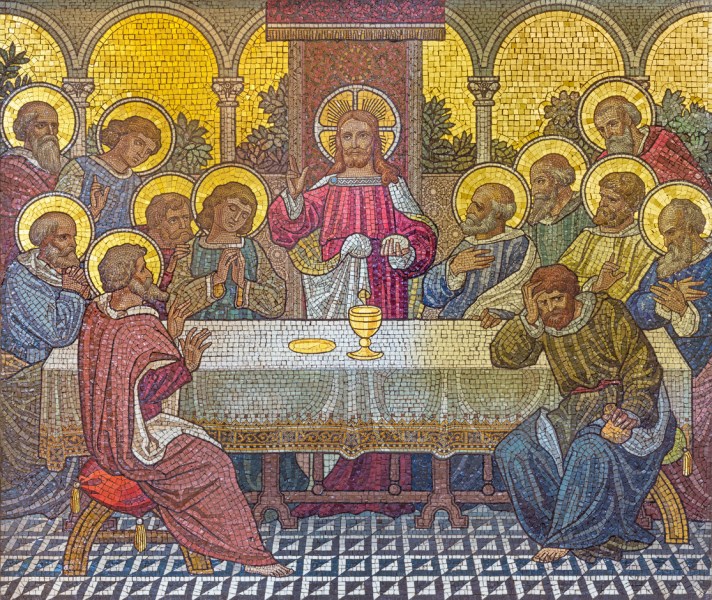
Following the Passover Meal, Jesus prepares his disciples telling them he is about to leave them, but he will send the Paraclete in his place.  

I have said these things to you, that in me you may have peace. In the world you will have tribulation… (ibid 16:33a)

He knows they will suffer the loss, not least, initially in their faith that the broken man on the cross was not the Messiah they hoped he was.  With the exception of John, performing the family duty of supporting his aunt, Mary, the disciples would scatter and return to Galilee.

But it easy to pass over his summary statement, that he has ‘overcome the world’, noting this is a completed action, in other words, he can surrender to death knowing he is sinless, and that is a victory. 

The Greek verb νικάω nikaó means to vanquish, conquer, prevail over and it derives from the Niké, the pagan goddess of victory.  So, Jesus saying that he has already won a victory even before passing test of obedience in Gethsemane, and rendering up his life and spirit to his Father.

Read more

REJECTION

For you know that afterwards, when he desired to inherit the blessing, (Esau) was rejected, for he found no chance to repent, though he sought it with tears.  

(Hebrews 12:17)

To the author of Hebrews, Esau is cautionary example.  This book of the New Testament is a warning to Jews of the early Church to not turn their back on their faith that Jesus is their Messiah, the fulfilment of the Law and the Prophets, their Scripture.

Exhorting them to endure, he says this:

See to it that no one fails to obtain the grace of God; that no “root of bitterness” springs up and causes trouble, and by it many become defiled;that no one is sexually immoral or unholy like Esau, who sold his birthright for a single meal.  (ibid 12:15-16)

Esau came to regret his rash exchange of birthright and acts as a reminder to Jews contemplating apostasy, remember he could not reverse this decision – in this, he was ‘rejected’.  The word translated is ἀποδοκιμάζω(apodokimazó) and it means to disallow; therefore, it is important to confuse the denial of Esau’s request with ultimate rejection by God.  

Read more

WRITING (LAW)

The LORD… gave to Moses, when he had finished speaking with him on Mount Sinai, the two tablets of the testimony, tablets of stone, written with the finger of God. (Exodus 31:18)

The Jews were jealous of the Law of Moses, and when Jesus began to teach, many questioned his credentials.  This was one of the reasons that by the final year of his ministry (that would conclude at Passover 33AD) many were seeking to be rid of him. This came to a head the previous year at the feast of Tabernacles:

About the middle of the feast Jesus went up into the temple and began teaching. The Jews therefore marvelled, saying, “How is it that this man has learning, when he has never studied?” 

So, Jesus answered them, “My teaching is not mine, but his who sent me…” 

(John 7:14-16)

While some openly question whether Jesus could be the Messiah, Jesus goes on to make a different assertion, albeit indirectly; importantly, one concerning his Godly authority.

Read more

WITHHOLD

a man named Ananias, along with his wife Sapphira, sold a piece of property. With his wife’s knowledge, he withheld some of the proceeds from the sale. (Acts 5:1-2a; Common English Bible)

The Greek verb translated in many translations as ‘keep back’ but in the above more simply ‘withhold’ is νοσφίζω nosphizó ‘to sequestrate for oneself’.  The more common usage of this Greek word ‘to embezzle, pilfer or purloin’ is more problematic in the context of this singular incident that beset the foundational Church with fear when first Ananias and then his wife, were struck dead by God as the result of this act.  After all, as the head quotation shows this was Ananias and Sapphira’s asset to theirs to dispose of as they pleased; they stole from no one.  

Read more

Conscience

Therefore, it is necessary to submit to the authorities, not only because of possible punishment but also as a matter of conscience.  (Romans 13:5)

In the application chapters of his epistle to the Romans, Paul cycles through a number of scenarios where the justified walking the path of sanctification will be confronted with dilemma between conscience and commandment – in the case quoted above, to obey the God-appointed governing authorities.  Given that Paul appealed to Caesar and that emperor was Nero, the dilemma is immediately obvious.

But to understand better, one has to examine Biblically what is ‘conscience’.   The Greek word employed by Paul is συνείδησις syneídēsis is a compound of syn ‘together with’ and eido ‘to know or see’ and describes ‘shared understanding’.  Thus, conscience is the tempering of individual reaction and instinct with respect to others.  Conscience is also concerning with the regulation of conduct and this infers a concept of morality, hence it the Bible there is reference to ‘good’ conscience.  But the interesting consideration is how conscience might grow at all.

Read more

INVITATION (to dine)

When one of the Pharisees invited Jesus to have dinner with him, he went to the Pharisee’s house and reclined at the table.  (Luke 7:36)

Gospel accounts of Jesus dining with others are manifold.  The Greek verb φάγω phago means simply eat, but he is asked, ἐρωτάω erótaó, and his presence requested – in other words, he is invited – on many occasions, and by many different kinds of people.  There are those of high society, which in Jesus’ day, were the ultra-religious.  In addition to the head quotation, Luke records two other instances of Jesus accepting an invitation to dine in a Pharisees’ home, 11:37 and 14:1 but, of course, the Pharisees were also critical that Jesus was indiscriminate in his choice of table.

Read more

ARMOUR (of God)

Put on the whole armour of God, that you may be able to stand against the schemes of the devil. (Ephesians 6:11)

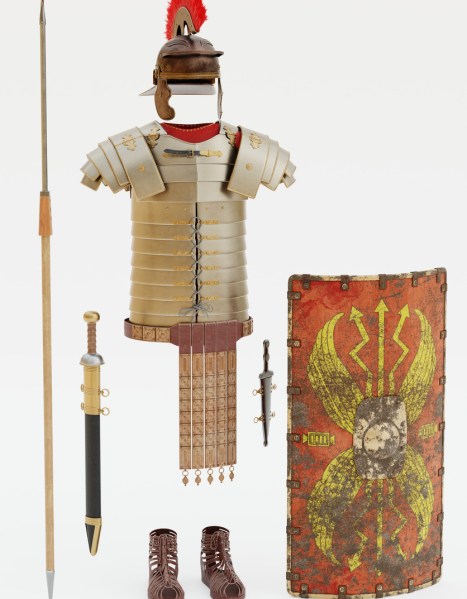
The ‘whole armour’ is the full set of equipment needed to wage warfare, and translates πανοπλία panoplia, whence English derives ‘panoply’.  Doubtless, he had in mind the Roman soldier fully furnished with helmet, breastplate, sandals and short sword.  To the Ephesians, Paul has already used the analogy of believers clothing themselves, ‘putting on’ (the verb ἐνδύω enduo, to be clothed or enveloped) the new self, the spiritual part downpayment of the new creation; but Paul would also have it known that this new spirit can come under attack.  

Read more

RESPECT

Always be prepared to give an answer to everyone who asks you to give the reason for the hope that you have. But do this with gentleness and respect, keeping a clear conscience, so that those who speak maliciously against your good behaviour in Christ may be ashamed of their slander. For it is better, if it is God’s will, to suffer for doing good than for doing evil.  (1 Peter 3:15-17)

If evangelism has become tainted with the association with ranting and bigotry then perhaps it is because not enough Christians took to heart what Peter says in his first letter.  What should characterise the messenger who brings the good news of Jesus, who gave of himself to redeem humankind, is contained in the two words translated as gentleness and respect; the evangelist should speak gently and respectfully.

Read more

WILFUL

For we, wilfully sinning after the receiving the full knowledge of the truth, no more for sins does there remain a sacrifice  but a certain fearful looking for of judgment, and fiery zeal, about to devour the opposers…(Hebrews 10:26)

This notoriously difficult and controversial passage reads this way in the NIV.

Read more

Doubt (of the faithful)

Then the eleven disciples went to Galilee, to the mountain where Jesus had told them to go. When they saw him, they worshipped him; but some doubted. (Matthew 28:16-17)

 Now the Greek word in this passage that is translated as doubt is the verb διστάζω distazo, which means literally two-fold or double stance. To be caught between two positions, to vacillate.

Read more